


How does ABA therapy help children use skills in real life? ABA therapy helps children apply learned skills across different environments through a process called stimulus control transfer. This process shifts a child’s reliance from prompts to natural, real-life cues rather than on prompts like verbal instructions or physical guidance.
In other words, stimulus control transfer is what bridges the gap between practicing a skill in therapy and using it independently in everyday situations, with different people and across environments.
In this guide, we’ll break down what transferring stimulus control means, how the three core procedures work, and what parents and educators can do both separately and together to support lasting, meaningful progress.
What is Transferring Stimulus Control in ABA?
Transferring stimulus control refers to the process of shifting a child’s reliance from prompts (such as verbal cues, gestures, or physical guidance) to natural cues in their environment. Ultimately, the goal is to foster your child’s independence so that they respond correctly without requiring any adult intervention.
In the stages of early learning, prompts are critical. A certified BCBA therapist may use a tool such as a visual prompt ABA strategy, or structured support within NET in ABA (Natural Environment Teaching) to guide correct responses. Over time, it’s these prompts that must be diminished or faded so the natural environment takes over.
According to the Association for Science in Autism Treatment, prompt fading and stimulus control procedures are core components of evidence-based applied behavior analysis, whereby they help learners transfer skills from structured teaching environments to real-world situations1.
This process is often coupled with structured supports, such as error correction, to ensure your child can practice the correct response consistently while reducing their reliance on assistance. If your’re noticing your child still depends heavily on prompts, contact Heartlinks ABA to learn how we can support more independent, real-life skill use.
What is a discriminative stimulus?
A discriminative stimulus (SD) is simply the cue that signals a specific behavior should occur. For example, if a teacher says ‘line up’ or a parent holds their hand up for a high-five, these actions indicate to your child what should happen.
Unlike discriminative stimulus control, stimulus control transfer is designed for the child to respond to their natural cues rather than to prompts such as “say hi” or a physical nudge.
Why does prompt dependency happen, and why does it matter?
Prompt dependency occurs when a child waits for help instead of responding independently. Often this happens when prompts are not faded systematically.
Situations when this pattern develops include:
- When skills don’t transfer easily to new environments
- A child’s independence is limited
- Their rate of learning slows down over time
That’s why transferring stimulus control is a crucial part of effective ABA programming.
If your child is showing signs of prompt dependency or difficulty generalizing skills at home or school, it may be time to explore a structured ABA program designed to build independence across environments. Contact Heartlinks ABA today at a location nearest you.
The 3 Core Procedures for Stimulus Control Transfer ABA
Three primary strategies are used to transfer stimulus control. These methods, in combination with various ABA therapy techniques such as ABA shaping and consistent reinforcement ABA, are designed to strengthen independent responses. Foundational research by O. Ivar Lovaas demonstrated that structured behavioral interventions, including prompting and systematic fading, can significantly improve independent functioning and skill generalization in children with autism2.
Prompt Fading
Fading is one of the types of prompting in ABA. It is the systematic or gradual removal of prompts (i.e., hints or assistance) that’s used to teach a skill. The goal of prompt fading is to transfer control from the helper to the natural cue. Prompt fading is designed to prevent prompt dependency, where a learner relies on assistance to perform a task. Instead, prompt fading is designed to encourage an autistic child’s independence, ensuring the skill can be used across various situations.
For example:
Moving from full physical guidance to partial physical, then to a gesture, and finally to an independent response. The key is to fade prompts slowly enough that the child continues to succeed, but quickly enough to avoid dependency.
Time Delay
Time delay introduces a pause between the instruction and the prompt. The idea is by gradually increasing this delay, the learner is prompted to respond independently to the natural cue. As a result, this ensure a transfer of control from the teacher’s help to the stimulus itself.
For example:
Your child’s therapist may say, “Touch your head,” wait a few seconds, then prompt or show them how to touch their head. This creates an opportunity for the child to respond independently before help is given.
Stimulus Fading
Stimulus fading involves gradually changing aspects of the environment so that the natural cue becomes more noticeable. Stimulus fading prompts independent responding by slowly altering a dimension of the prompt until it is completely gone.
For example:
Highlighting the correct answer visually, then slowly removing that highlight. Over time, the child will learn to respond to the natural cue without added support.
Transferring Stimulus
Parents play a tremendous role in helping skills to carry over beyond therapy sessions. Using ABA therapy at home strategies ensures that learning continues in everyday routines.
Using Natural Cues in Daily Routines
Daily life is full of natural opportunities to reinforce skills:
- Asking your child to put on shoes when it’s time to leave
- Encouraging communication during meals
- Practicing social skills during playtime
Approaches such as NET in ABA are particularly effective because they teach autistic children the skills in the specific context where they’ll actually be used.
How to Fade Prompts Without Causing Frustration
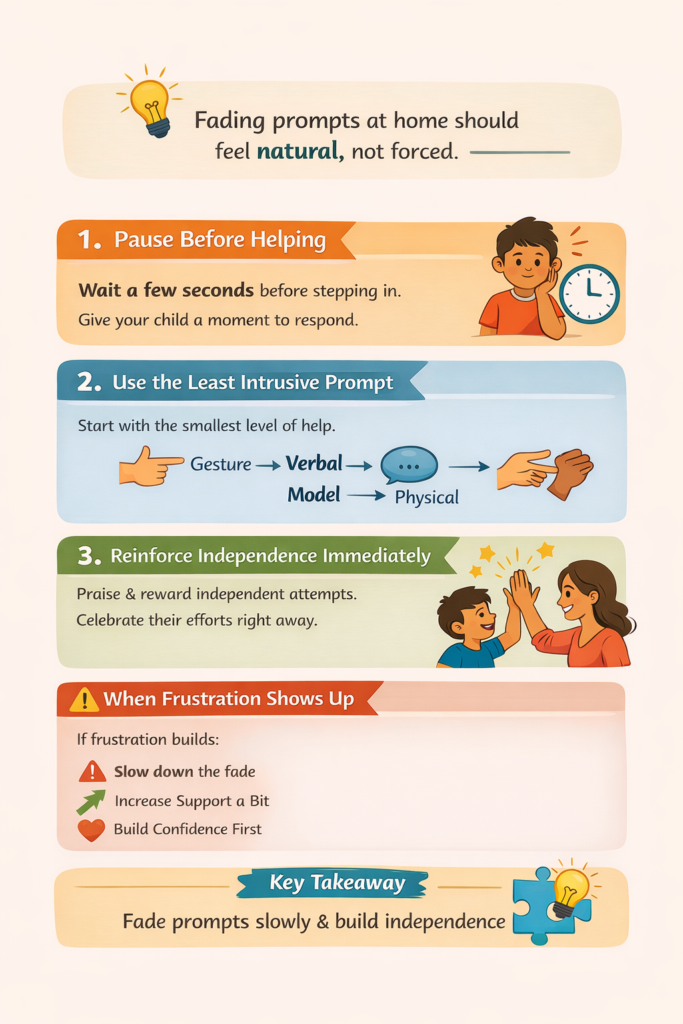
If you’re working on building independence at home but aren’t sure how to fade prompts effectively, you’re not alone. The right guidance can make all the difference. Contact Heartlinks ABA to learn how our specialized team supports families with real-life ABA strategies that help skills carry over beyond therapy sessions.
Transferring Stimulus Control at School: Working with Educators

School environments often add complexity due to multiple teachers, peers, and expectations. Collaboration is crucial in situations like these. Using strategies like task analysis, ABA can help break down skills, so they’re easier to generalize across settings.
Understanding how to implement and coordinate these strategies is crucial for those pursuing a career in ABA. Many of these skills are foundational to RBT (Registered Behavior Technician) training.
Collaboration with Teachers on Prompt Fading Plans
Consistency is critical. Parents and therapists should work with teachers to:
- Use similar prompts
- Follow the same fading sequence
- Reinforce independence in the same way
Without alignment, children may become easily confused or frustrated and revert to their former prompt-dependent behaviors.
Generalization Across Settings and People
Generalization in ABA therapy is a child’s capacity to apply learned skills across different settings, people, materials, and times. It ensures that skills taught in a controlled environment (like a clinic) can be transferred to authentic situations, such as at home or in school. Generalization is critical in ABA therapy because it encourages independence rather than simply complying with what the instructor says.
Generalization means a child can use a skill:
- In different locations
- With different people
- In different situations
This is the ultimate goal of transferring stimulus control: building true independence and functional, real-world skills through applied behavior analysis interventions.
When skills aren’t carrying over between home and school, it often comes down to how stimulus control is being transferred. Heartlinks ABA partners closely with families and educators to ensure consistency across environments. Contact Heartlinks ABA to learn how we help children develop their independence across every setting.
How Heartlinks ABA supports Stimulus Control Transfer
At Heartlinks ABA, the transfer of stimulus control is integrated into every treatment plan. Our team focuses on helping children move beyond structured sessions and apply the skills they’ve learned where they matter most, whether that’s at home, in school, or in the community.
A certified BCBA therapist uses customized prompt-fading plans, real-world practice opportunities, and close collaboration with families and educators to foster genuine independence. Every step is designed to ensure that progress isn’t limited to therapy sessions but is integrated into daily life.
Families consistently see the impact of this approach. As one parent, Fernanda L., shared:
“A very trustworthy agency, my daughter and I are very happy with our therapist, who comes to our house. Victoria adapted super quickly with her therapist because she knows how to introduce herself to Victoria’s world. She’s very respectful of Victoria’s needs and knows exactly how to support my daughter. Again, I’m very happy and grateful we found this ABA agency.”
Heartlinks ABA proudly serves families in multiple locations, including:
- ABA Charlotte NC
- ABA therapy New Jersey
- ABA therapy Atlanta, GA
- ABA therapy Indianapolis
- ABA therapy Baltimore, MD
If your child’s ABA skills aren’t being easily transferred into daily life, Heartlinks ABA can help. Contact Heartlinks ABA to learn how we build independence at home and school.
Frequently Asked Questions About Transferring Stimulus Control
When should you use transferring stimulus control?
You should gradually fade prompts, provide opportunities for independent responding, and consistently reinforce correct behavior. The goal is always to shift control from prompts to natural cues.
What are three ways to transfer stimulus control?
The three primary methods are prompt fading, time delay, and stimulus fading. These strategies work together to build independence over time.
What is stimulus control transfer in RBT?
For a registered behavior technician (RBT), stimulus control transfer involves implementing structured procedures, including prompt fading and time delay, while under the supervision of a BCBA to ensure clients respond independently to natural cues.
What is a real-life example of stimulus control transfer?
Take, for example, when a child learns to say “thank you’ when prompted by a therapist. Over a period of time, these prompts or ‘hints” are faded, and the child begins saying “thank you” independently when receiving something, whether it’s at home, at school, or in the community.
References
- Association for Science in Autism Treatment. (n.d.). Applied behavior analysis (ABA). Retrieved from https://asatonline.org/for-parents/learn-more-about-specific-treatments/applied-behavior-analysis-aba/
- Lovaas, O. I. (1987). Behavioral treatment and normal educational and intellectual functioning in young autistic children. Journal of Consulting and Clinical Psychology, 55(1), 3–9. https://doi.org/10.1037/0022-006X.55.1.3