


Verbal operants are a way to understand how language works by focusing on why a child is communicating in a certain way, as opposed to what they’re saying. In ABA therapy, the term ‘verbal operant’ refers to a system that classifies communication by its function, such as requesting, labeling, or responding. This is done so that therapists can teach language in a more practical, meaningful way.
Taking this approach is crucial to parents because a child’s capacity to talk isn’t just about vocabulary; it’s about using words effectively in everyday situations, from asking for help to having conversations. If these skills are developed in a balanced way, children are better equipped to communicate their needs, connect with others, and manage their daily lives more independently.
In the following guide, we’ll break down the core types of verbal operants, explain how they work, and show how they support your child’s overall language development.
What is a verbal operant?
In verbal operants ABA therapy, a verbal operant refers to a type of language that is defined by its function, what the speaker is trying to achieve, rather than how the words sound or look. This concept originated from B.F. Skinner’s analysis of language and behavior supported subsequent research on verbal behavior interventions.1
Why ABA categorizes language by function, not form
Traditional language development often focuses on vocabulary size or sentence length. ABA takes a different approach by asking, “Why is the child using this word?” For example, saying ‘water’ to request a drink serves a completely different function than saying ‘water’ to label a picture. This functional lens is what makes ABA therapy particularly effective for building meaningful communication.
How verbal operants differ from general speech or vocabulary.
A child may have tremendous difficulty communicating if they can’t use language across different situations. Verbal operants allow therapists to break communication into specific skill areas, identify gaps, and build a more balanced, functional language.
The 4 Core Verbal Operants in ABA
The foundation of communication development is based on four primary verbal operants. Understanding the four core verbal operants ABA therapists teach can help parents recognize how communication develops step by step.
Mand-requesting what you need or want
A mand is a request. This is often the first type of communication children learn because it directly benefits them. For instance, a child saying ‘juice’ when thirsty is manding. You can explore other examples of mands to see how requesting develops over time.
Tact-labeling the world around you
A tact is when a child labels or describes something they hear, see, or experience, for example, saying ‘dog’ when pointing to a dog or uttering the word ‘cold’ when they venture outside without a coat in the snow. Tacting allows children to build vocabulary and share observations, which supports more natural interactions throughout the day. As these skills are strengthened, children on the spectrum become better at connecting words to the world around them, exploring more tacting examples to see how this looks in practice.
Echoic-initiating and repeating speech sounds
Echoic means exactly what it sounds like: repeating what someone else says. For instance, if a parent says ‘ball’ and the child repeats ‘ball’, that is an echoic response. Early language development is especially important and closely connected to echolalia treatment strategies that help shape meaningful speech.
Intraverbal-responding in conversation without a visual cue
Intraverbals are used in conversations without a direct visual prompt. For example, if you ask your child, “What did you have for breakfast?” and they respond, “cereal,” this exchange supports back-and-forth communication and social interaction.
Why the Verbal Operant Framework Matters for Autistic Children
The verbal operants ABA framework helps therapists identify which communication skills are developing appropriately and which may require additional support.
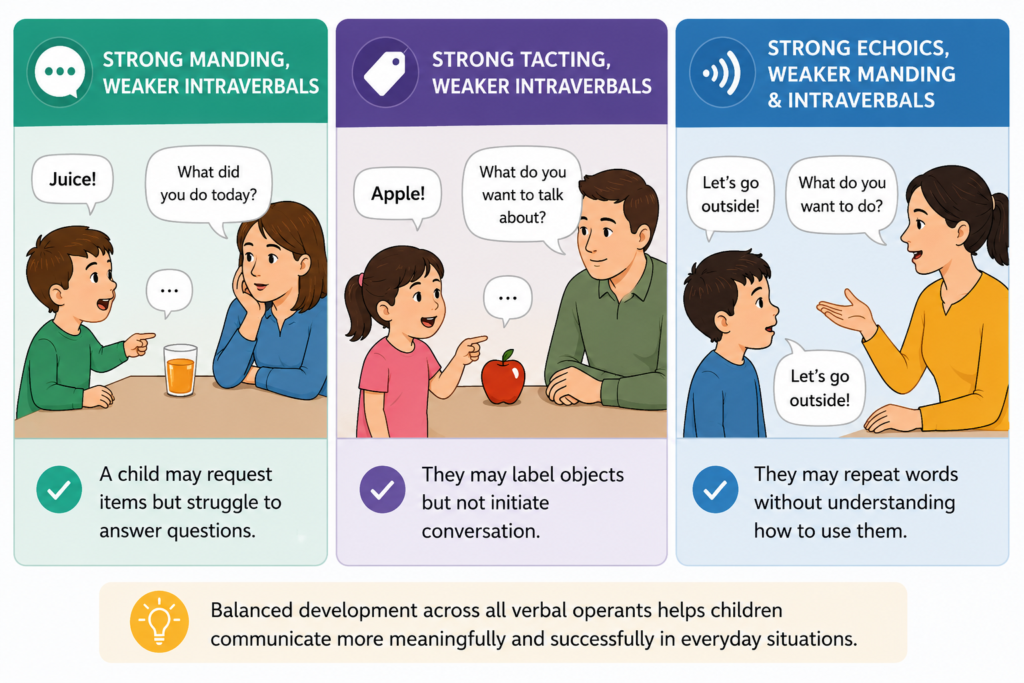
Why strong manding does not equal strong communication overall
Many children develop strong requesting skills early on. However, being able to ask for items does not necessarily mean they can label, imitate, or engage in conversation. This is why a balanced approach, often supported through early intervention ABA and ABA therapy for speech delay, is crucial.
If your child can request items but continues to struggle with conversation or social communication, Heartlinks ABA can help identify which verbal operant skills need support. Contact our team today to learn more about personalized ABA therapy programs.
How imbalances across operants show up in daily life
When one operant is stronger than others, it can impact daily interactions.
Families often notice these differences in everyday routines well before they know the term ‘verbal operant.’ As one Heartlinks ABA parent, Sevda H. shared, “We have an amazing therapist, Alayna, she has become a part of our family, and my son has excelled so much after she became his therapist.”
How ABA Therapists Teach Verbal Operants
Assessing verbal operant skills at intake
To start, a certified BCBA therapist will evaluate an autistic child’s current communication abilities across all operants. Doing so helps them identify the child’s strengths, gaps, and intervention priorities.
One Heartlinks ABA parent, Brittanie M., shared, “We love Heartlinks!! From when we signed up, the office team has been there for me every step of the way. I’ve been with other companies before, and the communication here is on a whole different level!! … They don’t treat you like just another case, they really care about your family and what you need. And now we have an amazing team, and I honestly couldn’t ask for anything better!!!”
Every child develops communication differently. A comprehensive assessment can help determine where your child is across all verbal operants and ABA skill areas,s and what support may help most.
Discrete Trial Teaching vs. Natural Environment Teaching
Two primary methods are used to teach verbal operants:
- Discrete Trial Teaching (DTT): This approach involves structured, repetition-based learning that includes clear prompts and strong reinforcement ABA.
- Natural Environment Teaching (NET): NET in ABA involves teaching language in real-life situations, such as play or throughout daily routines.
Often, both approaches are used together to help children learn more effectively and increase their ability to generalize skills across different environments.
Not sure which ABA approach is right for your child? Heartlinks ABA combines structured learning with natural play-based interactions to help children building practical communication skills. Get a personalized plan tailored to your child’s needs and developmental goals.
What can parents do to support verbal development at home?

Parents can play a critical role in reinforcing communication skills when their child is not in therapy. Incorporating ABA therapy at home strategies can make a significant difference in a child’s life.
Simple Routines that Build Requesting and Labeling Skills
- Take a moment and pause before giving your child a preferred item to encourage them to request it.
- Label objects during play, such as saying “that’s a train!” when your child picks the corresponding toy.
- Provide choices to prompt communication (e.g., “Do you want juice or milk?”).
How to Encourage Conversation using fill-in-the-blank prompts
Using simple prompts such as “ready, set….” and then letting your child say “go!” can help them develop intraverbal skills. It’s these small interactions that can gradually expand into more complex conversations.
How Heartlinks ABA Supports Verbal Communication Development
Verbal operant development is integrated into every individualized treatment plan. Each certified ABA therapist focuses on developing your child’s communication skills not only functionally but also flexibly in real-life situations.
Each child receives a tailored approach that targets all areas of communication, ensuring that skills such as requesting, labeling, imitation, and conversation develop in tandem rather than in isolation.
Heartlinks ABA proudly serves families in multiple locations, including the following:
- ABA Charlotte NC
- ABA therapy New Jersey
- ABA therapy Atlanta, GA
- ABA therapy Indianapolis
- ABA therapy Baltimore, MD
If you want to understand where your child is across all areas of verbal communication, the Heartlinks ABA team can help. Contact us today.
Frequently Asked Questions About Verbal Operants in ABA
How do I know which verbal operants my child needs to work on?
What is required is a comprehensive assessment by a qualified ABA professional who can identify which areas of communication need the most support. Our team at Heartlinks ABA can conduct a comprehensive assessment to identify exactly where your child needs support and build a personalized plan from there.
If you want to better understand your child’s communication strengths and challenges, contact our team today to learn how ABA therapy can support the development of essential verbal operants and functional language skills.
What is a verbal operant in ABA?
A verbal operant is a type of language categorized by its function, such as requesting, labeling, or responding, rather than its structure or form.
What are 4 verbal operants in ABA?
The four core verbal operants are examples of mands (requesting), tacting in ABA (labeling), echolalia examples (imitation), and intraverbal (conversation).
What is an example of a verbal operant?
An example would be saying “water” to ask for a drink, which is a mand, while saying “water” when seeing a picture is a tact.
What’s the difference between a mand and a tact?
A mand is used to request something, while a tact is used to label or describe something in the environment.
At what age does verbal operant training start?
Verbal operant training can start as early as toddlerhood, particularly when communication delays are identified.
Communication growth starts with understanding how your child learns best. Whether your child is developing skills in requesting, conversation, or social interaction, Heartlinks ABA provides individualized support designed around real-life successes. Start with a consultation to explore how ABA therapy can help your child thrive.
Resources
- Skinner, B. F. (1957). A psychological analysis of verbal behavior. In Verbal Behavior (pp. 1–19). New York, NY: Appleton-Century-Crofts. Retrieved from https://bfskinner.org/wp-content/uploads/2014/02/A-Psychological-Analysis-of-Verbal-Behavior.pdf