


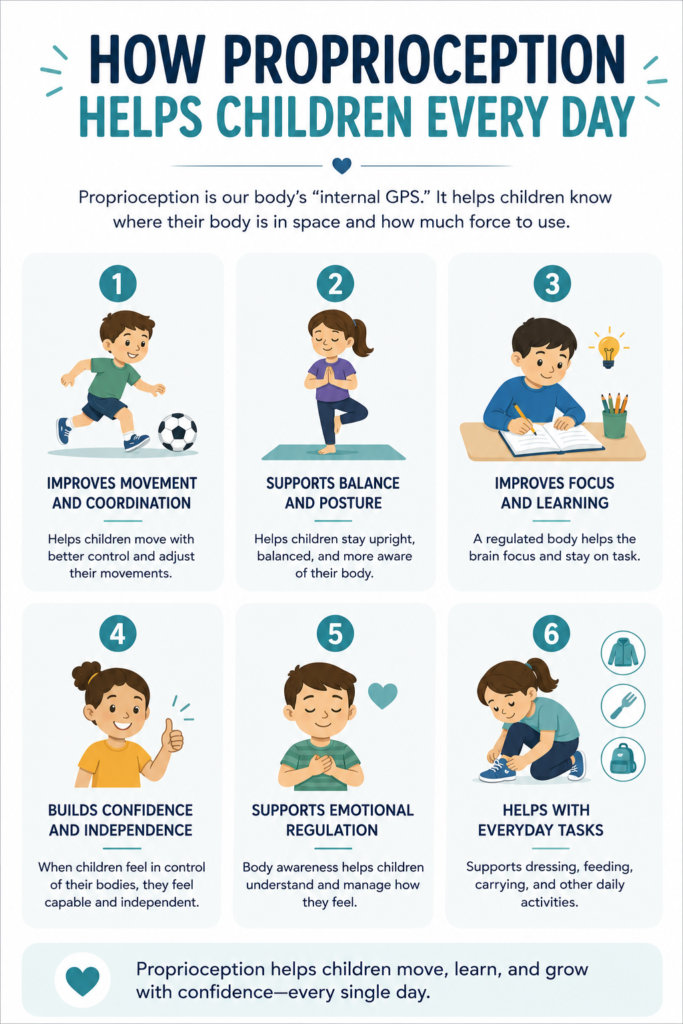
Proprioception in autism refers to differences in the body’s ability to sense movement, position, pressure, and coordination. It’s often referred to as the body’s “hidden sense,” and proprioception helps children understand where their bodies are in space and how much force to use during everyday activities.
Proprioception is the sensory system that helps the brain understand where the body is, how it is moving, and how much force muscles and joints are exerting at any given time.
Many autistic children experience proprioceptive challenges affecting body awareness, motor coordination, autism sensory regulation, posture, and behavior. This may look like crashing into objects, constantly jumping or seeking movement, appearing clumsy, chewing on items, or struggling to sit still and control body movements. Because proprioception affects how children physically interact with the world around them, challenges with this sensory system can impact learning, play, communication, and independence at home and school.
In everyday life, proprioceptive differences in autistic children may look like crashing into objects, constantly jumping or seeking movement, appearing clumsy, chewing on items, using too much or too little force during activities, or struggling to sit still and control body movements.
This is where ABA therapy can help children improve their body awareness and self-regulation through individualized sensory supports, structured routines, and behavioral strategies that build independence across home, school, and community settings. Many ABA programs for autism also incorporate sensory-based learning opportunities to help children better process movement and environmental input.
If your child struggles with movement, coordination, sensory regulation, or body awareness, contact Heartlinks to learn how personalized ABA therapy can support their development.
What is Proprioception in Autism?
In autism, proprioceptive differences can affect coordination, body awareness, movement control, autism emotional regulation, and sensory processing, often making everyday activities feel more difficult or overwhelming for a child.
Why proprioception matters for autistic children
Proprioception plays a significant role in helping children move safely, coordinate their bodies, regulate their energy levels, and complete everyday tasks independently.
Understanding sensory processing differences early can help children build confidence and independence. Reach out to Heartlinks ABA today to explore individualized support options for your child.
How Proprioception works and why it matters for autistic children
Whether you realize it or not, all of us rely on proprioception throughout the day to move through our environment safely and comfortably. A child’s brain uses proprioceptive information to adjust pressure, coordinate movement, and regulate physical responses automatically.
When this system is functioning differently, everyday activities such as walking or sitting can suddenly become more challenging. Children may accidentally bump into others or stationary objects, have difficulty gauging force, struggle with their handwriting, or constantly seek physical movement. Autistic individuals commonly experience sensory processing differences that can affect body awareness, coordination, movement, and responses to sensory input 1.
For many autistic children, proprioceptive input can also play a calming and organizing role. This is one reason why activities involving pushing, pulling, jumping, or deep pressure are often used to support autism sensory regulation.
Why Proprioception Differences Impact Body Awareness, Coordination, and Behavior in Autism
Proprioception differences can sometimes appear behavioral on the surface, but they’re often sensory-based responses.
For example, a child who regularly crashes into furniture may be trying to increase their body awareness. Or, a child who presses too hard while writing with a pencil may be struggling to judge force accurately. Others may engage in repetitive movements or stimming behaviors, such as finger-flicking or autism spinning, to regulate sensory input and feel more in touch with their bodies.
Understanding these behaviors through a sensory lens can help parents and clinicians provide more supportive and effective interventions.
Recognizing Proprioceptive Differences in Your Child
Proprioceptive differences can manifest in various ways, depending on how a child processes sensory input.
Under-responsive proprioception-sensory seeking behaviors
Children who are under-responsive to proprioceptive input will usually seek out intense movement, pressure, or physical activity to help their bodies feel more regulated.
Examples may include:
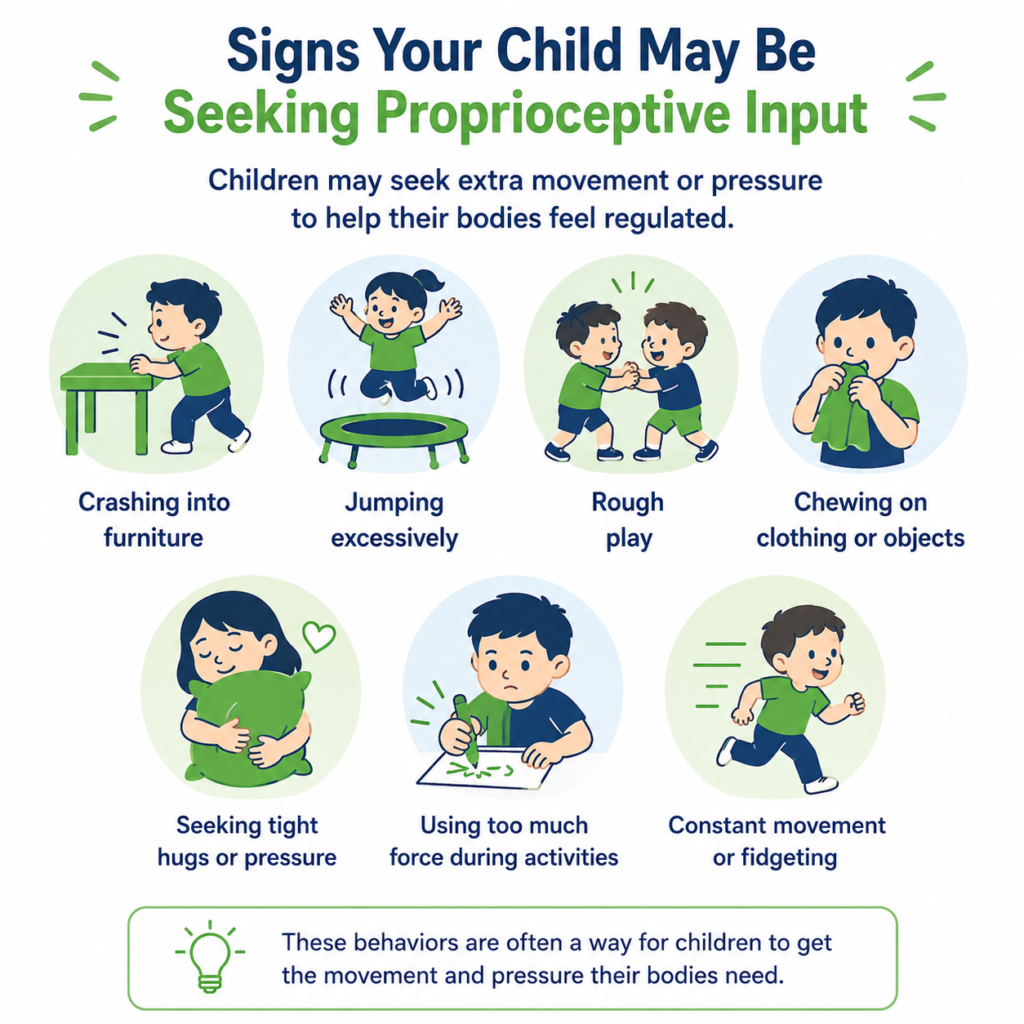
These sensory-seeking behaviors are often attempts to increase sensory feedback from a child’s environment.
Every child experiences sensory challenges differently. If you’re noticing sensory-seeking or sensory-avoidant behaviors at home or school, Heartlinks ABA is here to help.
Over-responsive proprioception-sensory avoiding behaviors.
Some children experience proprioceptive input as overwhelming or uncomfortable.
They may:
- Avoid physical activities
- Resist climbing or jumping
- Become extremely upset during transitions involving movement
- Dislike certain textures or physical sensations
- Appear cautious or fearful during play
These responses can affect participation at school, home, and in social settings.
How these patterns show up at home and school
Proprioceptive differences can affect many everyday routines, including the following:
- Sitting still during class
- Participating in sports or playground activities
- Dressing independently
- Fine motor tasks or handwriting
- Autism emotional regulation
- Transitioning between activities
- Maintaining personal space
Sensory supports are often integrated into broader treatment plans because these challenges often overlap with a child’s behavior and autism communication needs.
What is Interoception and How Does It Connect to Proprioception in Autism?
Interoception and proprioception are tightly connected sensory systems that help children on the spectrum understand and regulate their bodies.
Interoception-the sense of internal body signals
Interoception refers to the ability to recognize internal body sensations, including any of the following:
- Hunger
- Thirst
- Pain
- Temperature
- Fatigue
- Anxiety
- Bathroom needs
Sometimes, autistic children may have trouble identifying or responding to internal cues, which in turn can affect their emotional regulation, autism communication, and self-care skills. Research indicates that interoceptive processing differences in autistic individuals may influence emotional regulation, sensory processing, self-awareness, and daily functioning.2
Why proprioception and interoception are often addressed together in ABA
With both systems influencing autistic emotional regulation and body awareness, ABA programs can be customized to address these areas in tandem through structured teaching, movement activities, communication strategies, and sensory supports.
For instance, a child undergoing ABA therapy for speech delays may also be able to work on identifying body sensations, communicating discomfort, or learning coping strategies during sensory overload.
ABA therapy can help children improve body awareness, emotional regulation, communication, and daily living skills through structured, individualized support. Contact Heartlinks to learn more.
How ABA Therapy Addresses Proprioceptive Needs

From improving autism sensory regulation and coordination to building independence and body awareness, ABA therapy can help children on the spectrum with a range of skills.
How a BCBA assesses proprioceptive and body awareness challenges
A certified BCBA therapist evaluates how sensory differences affect daily functioning, learning, behavior, and communication.
This assessment may include:
- Observation across several different settings
- Extensive parent interviews
- Functional behavior assessments
- Sensory and motor skills observations
- Collaboration with occupational therapists and educators
The goal is to identify how a child’s sensory needs can influence a child’s ability to participate successfully in daily activities.
Families often notice meaningful improvements when sensory regulation and body awareness are addressed consistently within ABA therapy programs, including parent Kinjal S., who says:
“I have been connected with this agency for around 5 years, and it has been a wonderful experience. The staff is professional, supportive, and truly dedicated to the children and families they serve.
One thing I really appreciate is how much everyone genuinely tries to make a difference in the lives of the kids. The team is always willing to help, collaborate, and support both the families and the clinicians. They care deeply about each child’s progress and work hard to provide quality services.
I have also been very impressed with the Behavior Technicians through this agency. They are skilled, caring, patient, and experienced. It is rare to find such dedicated BTs who truly care about helping children succeed.
Overall, I highly recommend this agency. Their support, professionalism, and commitment to making a positive difference in children’s lives really stand out.”
Heavy Work Activities and Structured Motor Programs in ABA
“Heavy work” does not refer to manual labor; it refers to activities that provide an intense proprioceptive input to a child’s muscles and joints.
Examples include:
- Carrying weighted objects
- Pushing or pulling activities
- Climbing
- Animal walks
- Climbing
- Resistance Exercises
- Jumping activities
Many therapists also incorporate movement-based teaching strategies, such as NET in ABA, which allows children to practice skills naturally through movement, play, and real-world interaction.
Visual Supports and Spatial Awareness Strategies
Visual supports are designed to help children on the spectrum understand movement expectations, body positioning, and routines.
Common strategies may include:
- Visual schedules
- Floor markers
- Personal space visuals
- Movement breaks
- Step-by-step motor modeling
- Environmental organization
Whether used in combination or separately, these tools are designed to improve predictability, coordination, and independence.
What parents can do at home to support proprioceptive development
Parents can encourage and support proprioceptive regulation at home by incorporating structured movement opportunities, consistent routines, and simple ABA techniques into everyday activities. These ABA strategies for parents can help children build body awareness, emotional regulation, and independence outside of therapy sessions.
Heavy work activities to try between sessions
Several helpful activities may include:
- Carrying groceries
- Pushing laundry baskets
- Trampoline jumping
- Climbing playground equipments
- Wheelbarrow walks
- Building obstacle courses
Any of these activities can provide calming sensory input while improving coordination and body awareness.
How to tell if an activity is helping or overwhelming your child
Curious to learn if an activity is helping your child? The following are a few signs of success:
- More calm
- Better focused
- More organized
- Less impulsive
- More engaged socially
An activity may be overwhelming if your child exhibits the following behaviors;
- Agitated
- Dysregulated
- Withdrawn
- Aggressive
- Fatigued
Each child responds differently, so sensory supports should always be individualized and monitored carefully.
Finding the right sensory supports can take time, but individualized guidance makes a difference. Talk with the Heartlinks ABA team today about creating a personalized support plan for your child.
How Heartlinks ABA Supports Body Awareness and Sensory Regulation
Through personalized programming, movement-based learning, sensory supports, and collaboration with families, our clinicians help children build the skills needed to navigate everyday life more comfortably and confidently. Treatment plans are tailored to each child’s unique sensory profile and may include support for communication, self-regulation, movement coordination, and daily living skills.
Parents often report noticeable progress in communication, regulation, and everyday functioning after beginning individualized ABA support, including parent Bianca P., who says:
“I would highly recommend Heartlinks to any parent. My twins’ RBTs and BCBA are the best, best.<|join|>My twins’ RBTs and BCBA are the best. They provide the best care for my twins, and they have both progressed so much since we started Heartlinks. I can’t thank this company enough.”
At Heartlinks ABA, we also emphasize the importance of early intervention ABA, as early support can help children develop stronger sensory regulation, communication, and adaptive functioning skills over time. Depending on each child’s needs, services may include ABA in-home therapy, parent coaching, and individualized behavioral support plans designed to strengthen independence across environments.
Heartlinks ABA proudly serves families in multiple locations, including the following:
- ABA Charlotte NC
- ABA therapy New Jersey
- ABA therapy Atlanta, GA
- ABA therapy Indianapolis
- ABA therapy Baltimore, MD
If your child is showing signs of proprioceptive difficulties, Heartlinks ABA can help. One of our certified BCBAs can build individualized programs that address sensory needs alongside communication and behavioral goals. Contact Heartlinks ABA today.
Frequently Asked Questions
How does ABA therapy help with sensory processing?
ABA therapy helps by identifying sensory-related triggers, teaching coping and regulation strategies, improving communication, building adaptive skills, and incorporating structured sensory supports into everyday routines.
If your child struggles with sensory processing challenges that affect daily routines, communication, or behavior, Heartlinks ABA can help create an individualized therapy plan designed to support sensory regulation and greater independence. Contact our team today to learn more.
Is poor proprioception a symptom of autism?
Proprioceptive differences are common in autistic individuals, although they’re not considered a core diagnostic symptom of autism.
What are examples of proprioception in autism?
Examples of proprioception include a child crashing into objects, having difficulty judging force, poor coordination, excessive jumping, chewing on clothing, seeking deep pressure, or having difficulty with personal space.
What is the biggest red flag for autism?
There is no one single red flag for autism. But common early indicators could include communication delays, reduced social interaction, sensory differences, or adherence to rigid routines.
What is interoception in autism?
Interopception is the ability to recognize internal body sensations, including thirst, pain, hunger, or emotional states.
What heavy work activities help autistic children?
Heavy work activities may include pushing, pulling, climbing, carrying weighted objects, jumping, resistance exercises, obstacle courses, and animal walks.
Resources
- National Autistic Society. (n.d.). Sensory differences. https://www.autism.org.uk/advice-and-guidance/topics/sensory-differences
- DuBois, D., Ameis, S. H., Lai, M.-C., Casanova, M. F., & Desarkar, P. (2022). Interoception in autism spectrum disorder: A review. Frontiers in Neuroscience, 16, 875200. https://doi.org/10.3389/fnins.2022.875200