

Applied Behavior Analysis (ABA) therapy helps children on the spectrum develop communication, social, and daily living skills, all of which support and foster their long-term independence. While ABA can be delivered in several settings, many families find the benefits of home ABA therapy, including the fact that learning happens where children feel most comfortable, outweigh any other type of treatment. By working within everyday routines and familiar environments, therapists can teach practical skills that children can immediately apply in real-life situations. Below, we examine the key benefits of home ABA therapy.
Why Home ABA Therapy Can Be More Effective for Children with Autism
ABA therapy is internationally recognized as one of the most effective approaches for supporting children with autism. While ABA therapy can occur in a variety of settings, including clinics, schools, and community settings, many families find that home-based ABA therapy offers unique advantages that help their children learn more quickly and comfortably.
By working in a familiar environment, therapists can teach meaningful autism independent living skills during a child’s daily routines, such as getting dressed, making their bed, and brushing their teeth. From autism communication to independence and emotional regulation, in-home ABA therapy enables learning to occur organically in the environment where children spend most of their time.
Organizations like the Association for Science in Autism Treatment (ASAT) acknowledged ABA therapy as an excellent evidence-based intervention for autism. As such, they emphasize that teaching children skills in natural environments can greatly improve their engagement and help them apply what they’ve learned across everyday settings.1
Learn more about parent techniques for home motivating operations ABA, in our parent training guide.
Key Benefits of Home ABA Therapy for Children With Autism
One of the greatest benefits of home ABA therapy is that a certified BCBA therapist can teach essential developmental skills in the exact environments where they’ll be used most often. Many families choose home based autism therapy because it enables therapists to integrate learning directly into a child’s daily life.
Building Communication Skills in Everyday Moments
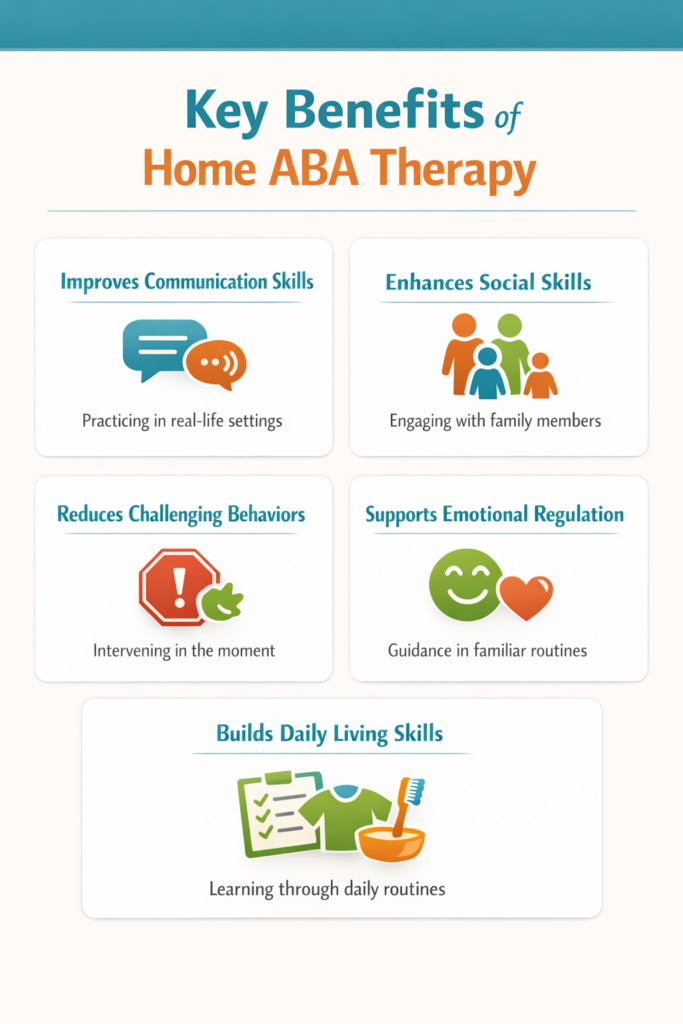
Autism communication is often a primary focus of ABA therapy. In a home setting, a certified ABA therapist can teach essential developmental skills in the exact environments where they’ll be used most often. Many families explore home based autism therapy because it allows therapists to integrate learning directly into a child’s daily life.
Early communication is particularly important. Research indicates that recognizing developmental differences early and then taking swift action can tremendously improve the developmental outcomes for children with autism and other developmental conditions 2.
Developing Social Skills Through Natural Interactions
Home environments provide valuable opportunities for children to develop the social skills they need through authentic interactions with family members and peers. A certified ABA therapist has the skills and expertise to guide children through activities such as sharing toys, taking turns, and participating in conversations.
Many ABA programs also use therapy for social skills, such as modeling ABA, reinforcement, and structured play. By practicing these skills with siblings and other family members, autistic children can build the confidence they need and develop more meaningful connections with others.
Reducing Challenging Behaviors in Real-time
Some behaviors occur most often at home, whether during mealtimes, transitions, or bedtime routines. In-home behavioral therapy allows a certified BCBA therapist to directly observe these situations and then implement targeted strategies to address them.
Through structured behavior reduction ABA plans, therapists can identify triggers for challenging behaviors, including situations sometimes described as autistic defiance, or patterns related to autism and crying, and teach children more effective alternative responses that better meet their needs.
Thanks to the fact that therapists can intervene during real-life moments, children have more opportunities to learn safer and more effective behaviors.
Supporting Emotional Regulation and Self-Regulation
From managing sensory input to handling frustrations and transitions, children on the autism spectrum often have difficulty learning how to regulate their emotions, depending on the situation. That’s where in-home ABA therapy provides a supportive environment where therapists can help children develop coping strategies and emotional awareness.
A certain number of these challenges are connected to behaviors such as escape in ABA, where a child might try to avoid or leave a difficult task. In a home setting, therapists can address these patterns by employing strategies such as functional communication training (FCT), demand fading, and visual supports that align with familiar routines.
The techniques used to support autism emotional regulation may include identifying emotions, practicing calming strategies, and understanding how to request breaks when they become overwhelmed.
Over time, these strategies help children build greater independence in managing their emotions.
Building Daily Living and Independence Skills
Daily routines provide tremendous opportunities for ABA therapists to teach important life skills. These trained professionals may help children practice tasks such as dressing themselves, picking up their toys, following instructions, or completing simple household routines.
One commonly used teaching approach in in-home sessions is natural environment teaching ABA, which focuses on learning through everyday activities and play. Understanding NET in ABA helps explain why autistic children are more than likely to retain and apply the skills they’ve learned if they practice them in the same environment.
Benefits of Home ABA Therapy for the Whole Family
While therapy has a primary focus on helping the autistic child, families often reap the benefits of it as well. Another important aspect of the benefits of home ABA therapy is the level of involvement parents can have in the therapeutic process.
How Parent Training Amplifies Therapy Outcomes
Home based autism therapy allows parents to observe sessions and learn strategies to support their child’s development outside formal therapy.
Programs such as parent training ABA therapy, where caregivers of all types learn how to reinforce positive behaviors, foster autism communication development, and diffuse challenging situations. When caregivers consistently incorporate these strategies throughout a child’s day, they provide more opportunities to practice, thereby strengthening their skills.
Marisa Seiders shares her experience with Heartlinks:
“Heartlinks ABA has been great to work with for the past year and a half, and our in-home ABA technician, Seena, is absolutely amazing!”
It’s this kind of collaboration between families and therapists that ensures children can practice their skills consistently across home routines while parents gain confidence in supporting their child’s growth.
Flexibility, Convenience, and Reduced Family Stress
Traveling to therapy centers multiple times each week can place added strain on family schedules. In-home behavioral therapy eliminates commute time and allows sessions to fit naturally within daily routines.
This flexibility often makes therapy more sustainable for families while helping children remain comfortable in their familiar environment.
Is In-Home ABA Therapy Effective? What Research Shows
Historically, research has demonstrated that in home behavioral therapy can improve autism communication, social interaction, and adaptive behavior in autistic children.
According to research from the National Library of Medicine, when therapy occurs in natural environments, children often demonstrate stronger skill generalization and increased engagement.3,
Many professionals agree that one of the greatest benefits of home ABA therapy includes the ability to observe behaviors directly and tailor strategies to the child’s real-life routines.
Is ABA Therapy Better at Home or School?
Separately or together, home-based and school-based ABA therapy each play their own crucial role in an autistic child’s development. The focus of in-home therapy is often on autism communication, daily living skills, and autism emotional regulation. By comparison, in school settings, ABA therapy emphasizes academic performance and peer interactions.
For many children, a combination of environments allows skills to develop across multiple settings.
How Heartlinks Can Help You Get Started with Home ABA Therapy for Your Child

If you or your family are interested in learning more about in-home services, the best place to start is by finding a qualified ABA provider such as Heartlinks. We offer individualized treatment plans and ABA strategies that evolve to meet your child’s needs.
With locations in multiple regions of the country, including ABA Charlotte, NC; ABA therapy New Jersey; ABA therapy Indianapolis, and ABA therapy Atlanta, GA, Heartlinks can ensure your child receives customized care tailored to their developmental needs.
For more information on Heartlinks, schedule a consultation with Heartlinks to explore how in-home ABA therapy can support your child’s development.
Frequently Asked Questions: Home ABA Therapy Benefits
- What are the benefits of ABA therapy at home?
The benefits of home ABA therapy include learning the skills required to execute daily routines, improve communication, and foster independence.
- Does insurance cover home-based ABA therapy?
Often, ABA therapy insurance will cover home-based services deemed medically necessary.
- Is In-Home ABA therapy covered the same as center-based?
The majority of insurance providers offer similar ABA coverage insurance benefits for both in-home and center-based therapy.
- Is In-Home ABA Therapy Effective?
Research indicates that there are many benefits of home ABA therapy.
- Is ABA Therapy Better at Home or School?
ABA therapy can be effective in both settings, but home based autism therapy often focuses on daily routines and family interactions, while school-based programs emphasize academics.
- What to Expect with In-Home ABA?
Usually, a therapist works with your child in everyday routines, while a BCBA therapist oversees treatment plans, tracks your child’s progress, and navigates skill development.
Resources
1. Lovaas, O.I. (1987). Behavioral treatment and normal educational and intellectual functioning in young autistic children. Journal of Consulting and Clinical Psychology, 55(1), 3-9. https://pubmed.ncbi.nlm.nih.gov/3571013/
2. Association for Science in Autism Treatment (ASAT) – Summary of Research on ABA. https://asatonline.org/research-treatment/treatments/applied-behavior-analysis-aba
3. Vismara, Laurie A., and Sally J. Rogers. “Behavioral Treatments in Autism Spectrum Disorder: What Do We Know?” Annual Review of Clinical Psychology, vol. 6, 2010, pp. 447–468. National Institutes of Health. https://pmc.ncbi.nlm.nih.gov/articles/PMC4513196/.