


Anger and rage episodes for children with autism are not acts of defiance or bad behavior. Rather, they’re often signs of a breakdown in autism communication, self-regulation, and emotional dysregulation in autism, which can contribute to these episodes. Effective ASD anger management starts with understanding the root causes of autism rage, recognizing the stages of the rage cycle, and using evidence-based interventions such as ABA therapy to build lasting coping skills.
Why do autistic children experience anger and rage?
Autistic children experience the world with an incredibly heightened sense of intensity. Faced with sensory processing differences, communication challenges, and rigid cognitive patterns, they can easily all come together to create conditions where anger and autism rage can ignite very quickly. That’s why understanding the root causes is the first step toward meaningful ASD anger management.
Sensory overload as an anger trigger
There is a large portion of autistic children who are either sensory seeking or sensory avoidant and even sometimes both at varying times. Sensory input might seem ordinary to neurotypical children (i.e., a crowded hallway, fluorescent lighting, a scratchy tag on a shirt), but they can feel genuinely unbearable to autistic children.
Common sensory triggers include:
- Loud noises or sudden sounds
- Bright or flickering lights
- Uncomfortable clothing textures
- Strong smells
- Busy or crowded spaces
When sensory overload continues without any relief, frustration can quickly escalate into a meltdown or rage episode.
Communication frustration when words are not enough
Children on the spectrum with nonverbal autism or significant language delays may experience a heightened sense of frustration when they’re unable to express their needs. That’s where ABA therapy can help by incorporating functional communication training. Often families combine these services with autistic speech therapy to support communication development.
When a child is unable to communicate their needs effectively, they may experience one or a combination of these feelings:
- Feelings of happiness
- Increased frustration
- Emotional overwhelm
- Difficulty resolving problems independently
The inability to communicate discomfort, confusion, disappointment, or fear can result in behaviors that may appear aggressive to the untrained eye but are actually attempts to communicate distress.
As one Heartlinks parent, Chasity Y. shared:
“After only a few months of therapy, we’ve seen so much progress in our son. The weekly sessions and monthly check-ins showed us how much the Heartlinks team truly cares about our family’s success.”
Routine disruption and cognitive inflexibility
Many autistic children rely on predictability to feel safe and regulated. Unexpected changes can increase autism anxiety and contribute to autistic burnout, particularly when a child has limited autism coping skills available during stressful situations.
Examples include:
- A favorite activity being canceled
- Changes in school schedules
- Unexpected changes or visitors
- Altered bedtime routines
- Changes in transportation plans
Because flexibility can be difficult, even the slightest change or disruption may trigger emotional dysregulation that can escalate into anger or rage.
Is it a meltdown or a tantrum? What parents need to know.
Often, parents worry that a child is being oppositional or showing autistic defiance. However, understanding the difference between tantrums and autism is essential.
Typically, a tantrum is a means to an end. A child may throw a tantrum to obtain something they want or to avoid something they do not want. Once the goal has been achieved, the behavior subsides. Determining whether sensory or behavior factors drive a situation can help families choose the most effective response. Parents looking for help with autistic tantrums should initially focus on identifying the source of the distress.
Not sure if what you’re seeing is a meltdown or something else? Reach out to Heartlinks ABA today at a location nearest you to help you understand your child’s behavior, no commitment required.
Understanding the Autism Rage Cycle
What’s important to remember is that autism rage rarely appears without warning. Clinicians and BCBAs trained in ABA therapy can identify a predictable autism rage cycle with three distinct stages. Understanding each stage helps caregivers intervene earlier and respond more effectively, and it also helps to demystify autistic emotional regulation in ways that will reduce blame and guilt.
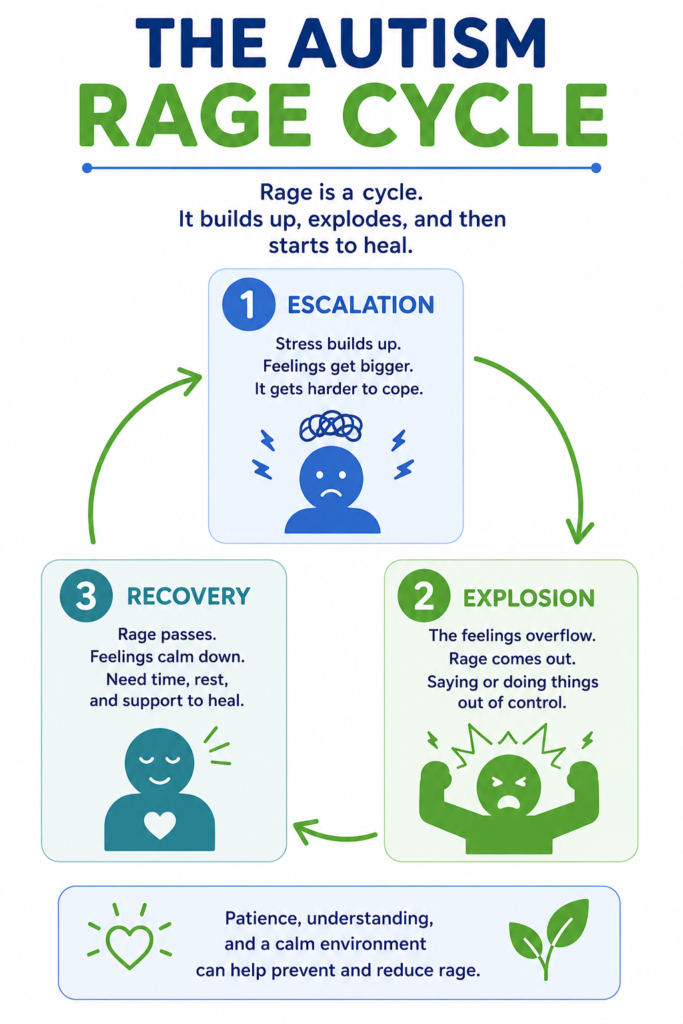
The Escalation Phase: What to Watch for Before the Outburst
Escalation: The build-up phase where frustration intensifies before an outburst
During the escalation phase, a child is showing early warning signs that they’re becoming overwhelmed. This might include increased stimming behaviors, covering their ears, autistic eye contact avoidance, becoming rigid or unresponsive, and escalating emotional dysregulation or pacing in autism. For children who experience understimulated autism states, this phase can be quieter, looking more like withdrawal than agitation. That’s why knowing your child’s specific escalation signals is one of the most important skills ASD anger management can build.
The Explosion Phase: What is Actually Happening
Explosion: This is the peak of the autism rage cycle, where the child has lost all regulatory control.
It’s during the explosion phase that your child is in full autism rage. Whether it’s screaming, hitting, biting, throwing objects, or engaging in self-injurious behavior, it all means the same thing-rage! This is certainly not willful behavior. Instead, the prefrontal cortex, which controls impulse control, has been completely bypassed by the emotional portion of your child’s brain. Autism and anger at this stage are not behavioral; it’s physiological. Any attempt to reason with, discipline, or direct a child during the explosion stage will not only be futile, but can also make the episode last longer or become more intense.
The Recovery Phase: Why Your Child Needs Time and Space
Recovery: The wind-down phase following an outburst, during which the child’s nervous system gradually returns to its baseline state.
After an autism rage episode, children on the spectrum are often exhausted, confused, and emotionally depleted. This pattern is often referred to as autistic burnout when it accumulates over time. They may cry, seek comfort, or simply go quiet. It’s important for parents to note this is not the time for consequences or to discuss what just happened. Rather, the recovery phase requires calm, reduced sensory input, and space. Once the child has fully returned to their baseline behavior, which can take anywhere from 20 minutes to several hours, it may be appropriate to begin gentle processing and skill-building.
Proactive ABA Strategies for ASD Anger Management
An effective ASD anger management plan is designed before any episodes occur. ABA therapy is structured around proactive planning. That means identifying what motivates your autistic child’s anger and then systematically reducing those triggers while building the skills they need to cope when they can’t be avoided.
Identifying and Documenting Triggers Using ABC Data
Antecedent, behavior, and consequence, or ABC data, is a fundamental ABA technique allowing therapists and parents to understand what motivates autism rage and anger outbursts. By tracking what happens before (the antecedent), what the behavior looks like, and what follows (the consequence), a BCBA therapist can identify patterns that wouldn’t naturally be evident. Questions they’d ask include: Is the child dysregulated after transitions? After lunch? In noisy environments? It’s this ABC data that helps to decipher what was once a mystery into a targeted behavior intervention plan (BIP in ABA), which then becomes the roadmap for all ABA strategies for parents to follow.
Visual Supports and Predictable Routines to Prevent Escalation
From visual schedules and visual prompt ABA to social stories ABA, several visual supports can provide autistic children with a reliable map of what to expect. When children on the spectrum can see and anticipate what comes next, changes like routine disruptions become far less destabilizing. For children requiring higher support needs, such as those with nonverbal autism, visual supports are often the strongest tool to prevent the escalation phase from starting. They are effective because they bypass the communication barrier and provide predictability.
Teaching Functional Communication as an Anger Replacement
Anger is often the only means of expression when an autistic child is unable to ask for a break, to communicate how they’re overwhelmed, or to tell an adult that a change in routine is too hard. Functional communication training (FCT) is an ABA technique that teaches children to use an alternative, appropriate communication behavior to achieve the same result.
Because every child has different triggers, these strategies should be individualized. Heartlinks ABA creates personalized plans based on each child’s needs and routines. Contact us to learn more about our services.
In-The-Moment ABA Strategies During An Outburst
Despite proactive support, anger outbursts can still occur. How caregivers respond in the moment can help reduce escalation and support recovery.
The 6-Second Rule: Why Timing Your Response Matters
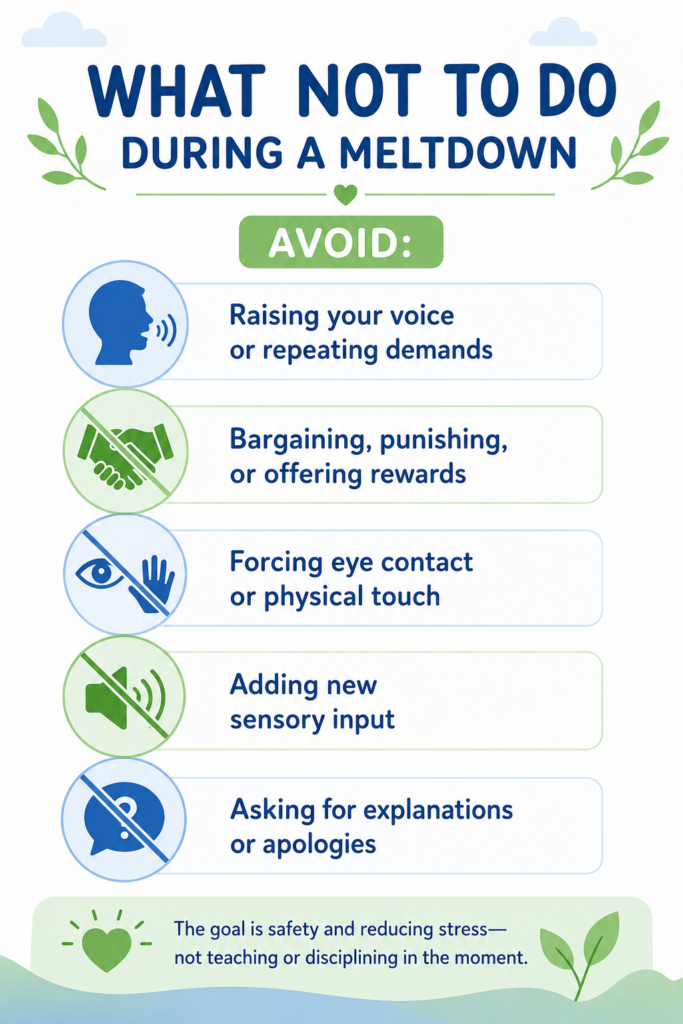
The famous 6-second drive encourages caregivers to pause before responding to a child. This gives both of them a moment to regulate. Reacting immediately with commands, raised voices, or physical guidance often can unintentionally increase a child’s distress level.
Neutral redirection and co-regulation
Neutral redirection simply means calmly guiding a child toward a safer or more calming activity without adding any emotional pressure. Co-regulation occurs when caregivers model calm behavior through their tone, body language, and actions.
What not to do during a meltdown
The following are a few suggestions of what not to do during your child’s meltdown.
Long-term skill building through ABA therapy
Certainly, immediate strategies to help your child are helpful; in essence, long-term progress often arises from teaching skills that improve your child’s autism emotional regulation over time. Research indicates that ABA therapy is effective in reducing a child’s aggression and improving emotional regulation 1.
Emotion Recognition and Interoception
Many autistic children are unable to recognize early signs of stress in their bodies. ABA therapy can help them identify physical signals, such as a racing heart or tense muscles, and connect them to emotions before anger escalates.
Practicing Coping Skills
From deep breathing and requesting a break to using a calming space, these are all tools a child can use to practice during calm moments. Alternatively, ABA therapists use modeling, role-playing, and positive reinforcement to help children apply these skills automatically when they feel their frustration rising.
Positive Reinforcement
Positive reinforcement is designed to encourage children to use coping strategies and self-regulation skills to manage their emotions. When autistic children successfully manage their frustration and communicate their needs appropriately, recognizing those successes helps strengthen the future use of those behaviors.
As Heartlinks parent Samantha P. shared:
“Shaindy, our Care Coordinator, was always accessible and proactive in helping our family navigate services. Our therapist was reliable, dedicated, and genuinely invested in our child’s success. We’re grateful for the support we received from Heartlinks ABA.”
How Heartlinks ABA Supports Anger Management
Heartlinks ABA is proud to develop customized anger management plans that address the underlying causes of your child’s emotional dysregulation. A trained BCBA therapist can assess your child’s triggers, communication challenges, and behavioral patterns before creating a personalized behavior intervention plan (BIP in ABA). We can also offer you and your family support and ABA strategies that parents can implement consistently at home.
We offer ABA in-home therapy as well as clinic-based services across several states, including:
- ABA Charlotte NC
- ABA therapy New Jersey
- ABA therapy Atlanta, GA
- ABA therapy Indiana
- ABA therapy in Baltimore, Maryland
Our team provides compassionate, evidence-based services that are designed to help children reach their full potential.
If your child’s anger episodes are frequent, intense, or getting harder to manage, Heartlinks ABA can help. Our BCBAs build individualized plans that address the root cause. Contact us today.
Frequently Asked Questions About ASD Anger Management
Why is my autistic child so angry?
Anger in autism is almost always rooted in one or more of three factors: sensory overload, communication frustration, or disruption to expected routines.
What is the 6 second rule in autism?
The 6-second rule refers to pausing for at least 6 seconds before responding to a child who is escalating.
What is the difference between an autism meltdown and a tantrum?
A tantrum is goal-directed behavior where a child is trying to get or avoid something. Usually it stops when the child either gets what they want or gives up trying. By comparison, an autism meltdown is a neurological loss of regulation, and it cannot be stopped on demand.
What is chinning in autism?
Chinning is a behavior in which an autistic child rubs their chin against surfaces or objects. It’s another form of sensory seeking.
How does ABA therapy help with autism anger management?
ABA therapy can address autism anger management at every level. This includes proactively identifying triggers and teaching communication skills, as well as long-term skills such as emotional regulation, interoception, and coping skills that can be applied to daily life.
Anger episodes do not have to define your child’s days – or yours. Heartlinks ABA builds the skills that make the difference. Reach out today.
Resources
- Purba, C. A. P., Febriyana, N., & Setiawati, Y. (2024). Managing aggressive behavior in adolescents with autism spectrum disorder: Pharmacological and non-pharmacological approaches. Journal of the Korean Academy of Child and Adolescent Psychiatry, 35(4), 223–229. https://doi.org/10.5765/jkacap.240026