

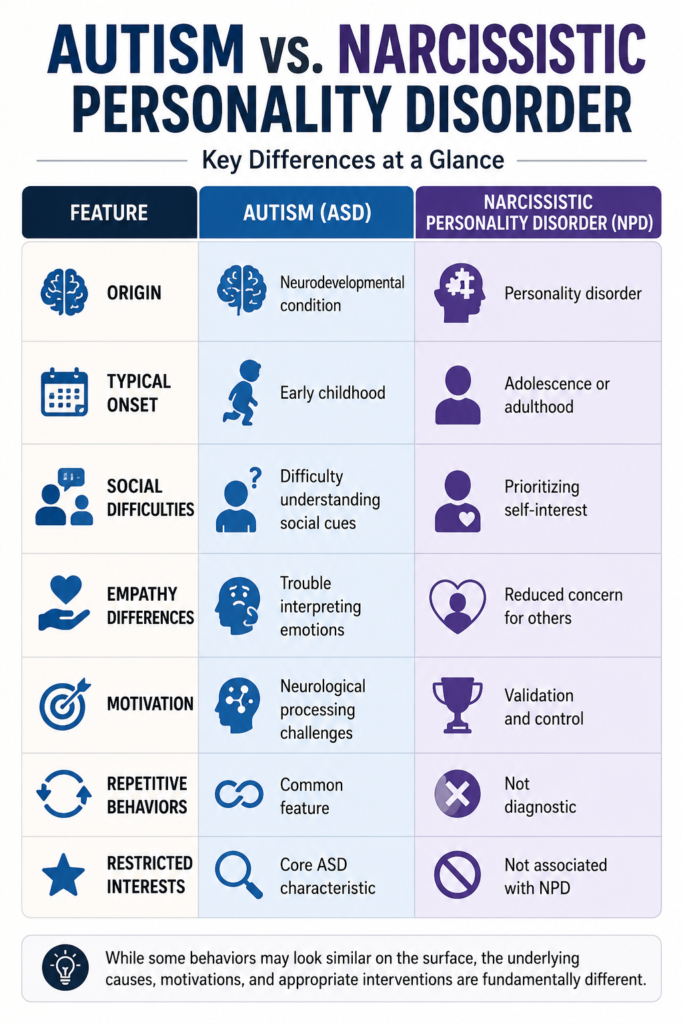
Narcissism vs. autism is a common point of confusion because some behaviors between the two can look similar on the surface. Autism is a neurodevelopmental condition that affects communication, emotional regulation, sensory processing, and social interaction.
By comparison, Narcissistic Personality Disorder (NPD) is characterized by persistent self-focused behavior, impaired empathy, and a strong need for validation. While autism and narcissism may share outward traits like social difficulties, emotional outbursts, or seeming self-absorption, the underlying causes, motivations, and appropriate interventions are fundamentally different.
Understanding the difference matters because a misdiagnosis can delay meaningful support and create unnecessary stress for families. In many cases, autistic behaviors are misunderstood as intentional rudeness, manipulation, or lack of empathy when they’re actually based on neurological differences. For families with children who are trying to determine whether autism may be an accurate diagnosis, getting the right diagnosis can affect everything from school support to treatment decisions, including whether ABA therapy may be beneficial.
Why Narcissism and Autism Get Confused
The Behaviors Look Similar from the Outside
Many of the behaviors that are associated with autism vs. narcissism can appear similar if you don’t have the context. An autistic child may avoid eye contact, which is one of several behaviors associated with autistic eye contact differences, have difficulty with reciprocity, interrupt conversations, or appear detached from other people’s feelings. Someone with narcissistic traits may also appear dismissive, socially detached, or unconcerned with others.
It’s this type of overlap that’s one of the reasons the autism vs. narcissism conversation confuses parents, teachers, and even healthcare providers.
Children with autism may have one or even a few of the following characteristics:<|join|>Children with autism may have one or even a few of the following characteristics:
- Prefer solitary activities
- Struggle with conversational flow
- Easily become overwhelmed in social settings
- Focus intensely on personal interests
- Experience emotional dysregulation during stress
Some children may also display sensory seeking behaviors, stimming behaviors, or difficulty regulating sensory input in overwhelming environments.
If someone is unfamiliar with autism spectrum disorder, the above-mentioned behaviors may look intentionally self-centered when they’re actually rooted in neurological differences.
Families who suspect their child may be misunderstood often benefit from learning more about the diagnosis of autism process and how clinicians evaluate social communication differences.
Why motivation and origin are the real differentiators
The key difference between narcissism vs. autism isn’t always the behavior itself; it’s the reason behind the behavior.
Autism is a neurodevelopmental condition that’s present from early childhood. Social difficulties, sensory processing differences, and autism communication challenges are not deliberate. They result from a genuine difficulty processing social information, sensory inputs, or emotional cues.
By comparison, narcissistic personality disorder involves long-standing personality patterns centered around self-importance, validation seeking, and lack of empathy. According to the American Psychiatric Association, NPD is characterized by grandiosity, an excessive need for admiration, and impaired interpersonal functioning 1.
An autistic child may miss social cues, but that is unintentional. Whereas, a person with narcissistic traits may recognize those cues but prioritize their own needs anyhow. It’s the difference in intent that is crucial to a proper diagnosis.
If you’re trying to understand better whether your child’s behaviors may be linked to autism rather than personality traits, learning more about ABA therapy and the diagnostic process can help families make more informed decisions.
Narcissism vs. Autism: Core Differences
Origin and Onset-Neurodevelopmental vs. Personality Disorder
One of the clearest distinctions between autism vs. narcissism is when and how the condition develops.
Autism spectrum disorder begins in early childhood and affects brain development. There are several different symptoms, including the following:
- Speech delays
- Sensory sensitivities
- Repetitive behaviors
- Social communication differences
Parents may also notice autism, hand flapping, finger flicking, and repetitive and restrictive behaviors during early childhood. Many parents seeking ABA programs for autism spectrum therapy report a series of developmental concerns that arise well before school age.
By comparison, narcissistic personality disorder is considered a psychological condition. Its symptoms typically arise later in life and involve a deeply ingrained relationship and issues around self-image.
Empathy: struggling to read cues vs. choosing to disregard them
Empathy is one of the most misunderstood areas when comparing autism and narcissism.
Children with autism often experience difficulty interpreting facial expressions, tone of voice, or indirect communication. This can give the impression that the child is emotionally detached, even when they deeply care about others. Children who’ve been diagnosed with nonverbal autism may particularly struggle to express empathy in expected ways.
In narcissism, a lack of empathy is generally tied to a focus on self rather than difficulty with communication. The issue is not confusion about social information, but rather a lack of emphasis on another’s emotional experience.
Autistic children may care deeply about others while still struggling to interpret social cues or express empathy in expected ways. Heartlinks ABA helps children strengthen communication, emotional understanding, and social interaction skills through individualized ABA programs. Contact Heartlinks to learn more.
Motivation: genuine difficulty vs. deliberate behavior
An autistic child who regularly interrupts conversations, has difficulty with transitions, or is transfixed about a specific topic is not usually attempting to manipulate others. This type of behavior often reflects challenges they experience with their executive functioning, sensory overwhelm, or difficulty recognizing conversational boundaries.
What may appear to be autistic defiance is often linked to overwhelm, anxiety, executive functioning difficulties, or emotional dysregulation in autism.
In narcissism, behaviors are more likely to serve interpersonal goals such as maintaining control, gaining admiration, or protecting self-image.
Understanding this difference helps families avoid assigning harmful intent to autistic behaviors.
Repetitive behaviors and restricted interests-a feature of autism, not NPD
Repetitive behaviors and restricted interests are fundamental features of autism spectrum disorder. These may include:
- Repeating phrases or movements
- Following rigid routines
- Developing intense interests in specific subjects
- Becoming distressed by unexpected changes
These behaviors can include autistic stimming examples such as hand movements, autism spinning, repetitive sounds, or sensory regulation behaviors. They are not necessarily associated with narcissistic personality disorder.
This distinction is critical because repetitive behaviors are often among the clearest indicators that a child may be autistic rather than narcissistic.
Where autism and narcissism overlap

Social withdrawal and apparent self-absorption
Frequently, children with autism sometimes appear socially withdrawn because interacting for them is exhausting, confusing, or overstimulating. They may retreat into familiar interests to self-regulate.
It’s this outward behavior that can often be misinterpreted as a narcissistic self-focus, even though the internal experience is completely different.
Emotional Regulation Difficulties
Both autism and narcissism can involve emotional dysregulation, even though the triggers are different.
Whether it’s the result of sensory overload, communication frustration, or unexpected transitions, autistic children often experience meltdowns. Emotional responses are often connected to overwhelm rather than interpersonal control.
Behavioral support strategies, such as ABA therapy for aggressive behavior, autism regulation strategies, and functional communication training, can help autistic children build coping skills in structured ways.
For many families, it’s that support which can significantly improve daily life and communication at home. As a parent, Zen C. shares:
“Our family loves Heartlinks ABA when we get services in-home ABA therapy. My daughter is very happy, and she really loves her teacher. Thank you, Heartlinks family.”
Rigid Thinking and Resistance To Change
Rigidity is often present in both conditions, but the differentiating factor is the motivation behind the behavior. About autism, routines create tremendous predictability and reduce anxiety. Resistance to change is often directly linked to nervous system regulation.
In narcissism, it’s the rigidity that may stem from a need to maintain control, authority, or the right self-image.
Can Autism be Mistaken for Narcissism?

How misidentification happens in families, schools, and clinical settings
Absolutely! Autism can sometimes be mistaken for narcissism, particularly when social communication differences are misunderstood.
Teachers or relatives may interpret autistic behaviors as:
- Self-centeredness
- Defiance
- Lack of empathy
- Emotional coldness
- Manipulation
This is particularly common in children with high-functioning autism traits who mask social confusion well.
Families who are in the process of undergoing a proper diagnosis of autism often receive conflicting feedback before their child is correctly evaluated.
Why Getting the Right Diagnosis Matters
Mislabeling autism as narcissism can delay meaningful support.
It has been shown that autistic children benefit from therapies designed to improve communication, emotional regulation, adaptive functioning, and social understanding. Without appropriate support, a child’s level of frustration and misunderstanding can increase over time.
Additionally, an accurate diagnosis can change how families interpret behavior. Rather than viewing their child as intentionally difficult, caregivers can begin to understand the neurological factors that are motivating those challenges.
Families who are navigating questions about autism, emotional regulation, or social communication challenges often benefit from early guidance and structured support. Heartlinks ABA offers individualized autism services, including ABA in-home therapy across multiple states.
How ABA Therapy Supports Autistic Children-Not Narcissistic Personality Disorder
What ABA addresses in autism: social communication, regulation, and daily skills.
Applied Behavior Analysis (ABA) therapy focuses on helping autistic children build practical communication, behavioral, and daily living skills. Unlike the varied treatment approaches for narcissistic personality disorder, ABA focuses on the developmental and neurological challenges that are commonly associated with autism.
A BCBA therapist or certified ABA therapist may use individualized ABA techniques, modeling ABA, ABA positive reinforcement, and task analysis ABA to support development. ABA therapy can help improve some of the following:
- Social communication
- Emotional regulation
- Adaptive daily living skills
- Functional communication
- Transition tolerance
- Behavioral flexibility
Children showing early signs of autism in the toddler years might benefit from early intervention services. For children on the spectrum with communication challenges, ABA therapy for speech delay may also support critical language development and functional communication skills.
Why ABA is not appropriate for NPD and what the difference means for families
ABA therapy is specifically designed to support autistic children by helping them strengthen communication, autism emotional regulation, social understanding, and daily functioning skills. It’s not considered an appropriate treatment approach for narcissistic personality disorder because the underlying causes and treatment goals are entirely different.
For families, understanding this distinction is critical. Because behaviors that may appear emotionally distant, rigid, or self-focused are often directly linked to sensory overwhelm, autism communication challenges, or neurological processing differences specific to autistic children, not the result of manipulation or lack of empathy. Receiving the correct diagnosis of autism can help families pursue meaningful support in a more timely manner and avoid misunderstandings that may increase stress at home, in school, and in social environments.
For many parents, receiving the right support can create meaningful changes in communication, behavior, and daily routines over time. As parent Renee G. shared:
“I’ve seen many changes with my son, thanks… thanks to the team who continue working with him.”
Heartlinks ABA is proud to provide individualized autism support and treatment for families through a multitude of locations, including:
- ABA Charlotte NC
- ABA therapy New Jersey
- ABA therapy Atlanta, GA
- ABA therapy Indiana
- ABA therapy in Baltimore, Maryland
If your child has received an autism diagnosis or you’re wondering whether behaviors you are seeing reflect autism, rather than personality traits, Heartlinks ABA can help. Contact us today.
Frequently Asked Questions
Are there similarities between autism and narcissism?
Yes, there are. Autism and narcissism can both involve social difficulties, emotional dysregulation, rigid thinking, and behaviors that may appear self-focused.
Can covert narcissism be mistaken for autism?
In some situations, covert narcissism can be mistaken for autism because both may involve social withdrawal, sensitivity, and interpersonal challenges. The difference lies in the motivation behind the behavior.
What disorder can be confused with narcissism?
Several conditions can be mistaken for narcissism, including ADHD, trauma-related disorders, autism, anxiety disorders, and certain mood disorders.
Can autism and NPD co-occur?
Although it is rare, autism and narcissistic personality disorder can co-occur. But because some symptoms may overlap on the surface, a qualified clinician must carefully evaluate developmental history, motivation, emotional functioning, and social behavior before making a diagnosis.
What conditions mimic autism?
Several conditions can mimic autism, including ADHD, social anxiety disorders, and sensory processing differences. These conditions may share symptoms like communication difficulties, emotional dysregulation in autism, or social withdrawal.
Understanding what your child is experiencing is the first step. If autism is part of the picture, Heartlinks ABA is here to help. Reach out today.
Resources
- American Psychiatric Association. (n.d.). Narcissistic personality disorder. American Psychiatric Association. https://www.psychiatry.org/news-room/apa-blogs/narcissistic-personality-disorder