

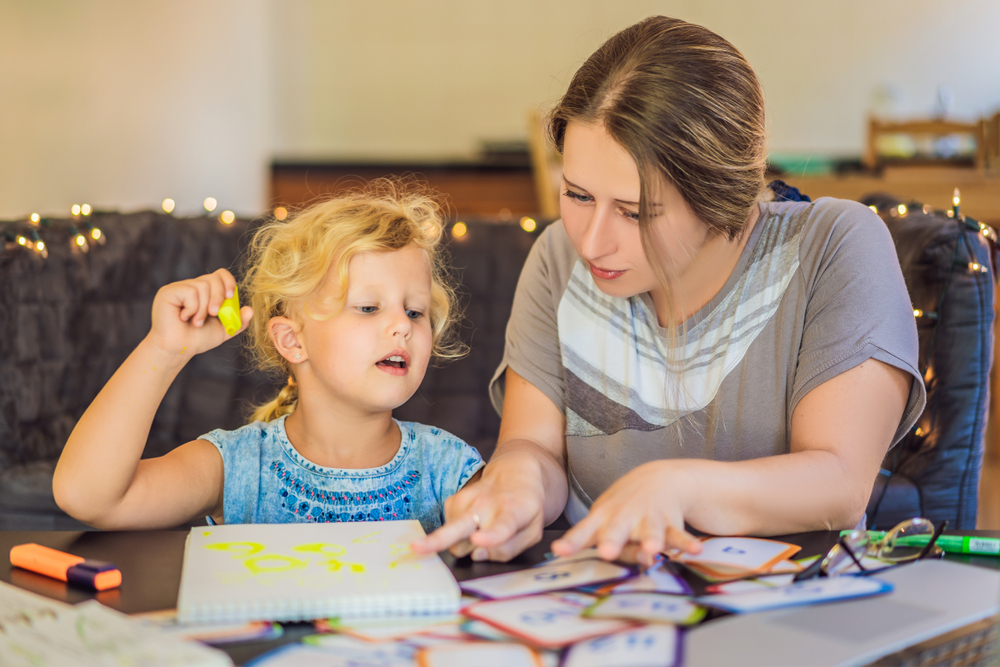
Once a family has received a diagnosis of autism, usually the next question is, “Should treatment happen in a clinic or at home? Home-based autism therapy enables children on the spectrum to receive customized support in the same environment where they spend most of their time: home.
Rather than traveling regularly to a therapy center, a trained BCBA therapist works directly with children in their homes, incorporating real-life routines to teach autism-related communication, social, and behavioral skills. For many families, this approach makes therapy more practical and comfortable while helping children apply new skills in their everyday lives.
Making informed decisions about your children’s therapy plans begins with understanding how home-based autism therapy works and when it might be the right choice for your family.
What is Home-Based Autism Therapy?
Any behavioral or developmental interventions that occur in a child’s home environment are considered home-based autism therapy. In most cases, this includes Applied Behavior Analysis (ABA), one of the most commonly used science-based therapies to support children on the autism spectrum. In fact, according to the National Institutes of Health (NIH) 77% of caregivers were informed of ABA services immediately upon their child’s diagnosis 1.
During these sessions, a certified ABA therapist works individually with a child, integrating their lessons into everyday activities such as playtime, daily routines, and meals. It’s this type of home-based autism therapy that often incorporates strategies such as NET in ABA (natural environment teaching in ABA), where skills are taught in authentic situations (as opposed to staged) rather than only in structured tasks.
There is tremendous research supporting the effectiveness of ABA-based interventions. According to the National Library of Medicine, research indicated that improvements across several areas, including cognitive skills, language, social communication, adaptive behavior, and autism symptoms, were achieved through ABA therapy 2.
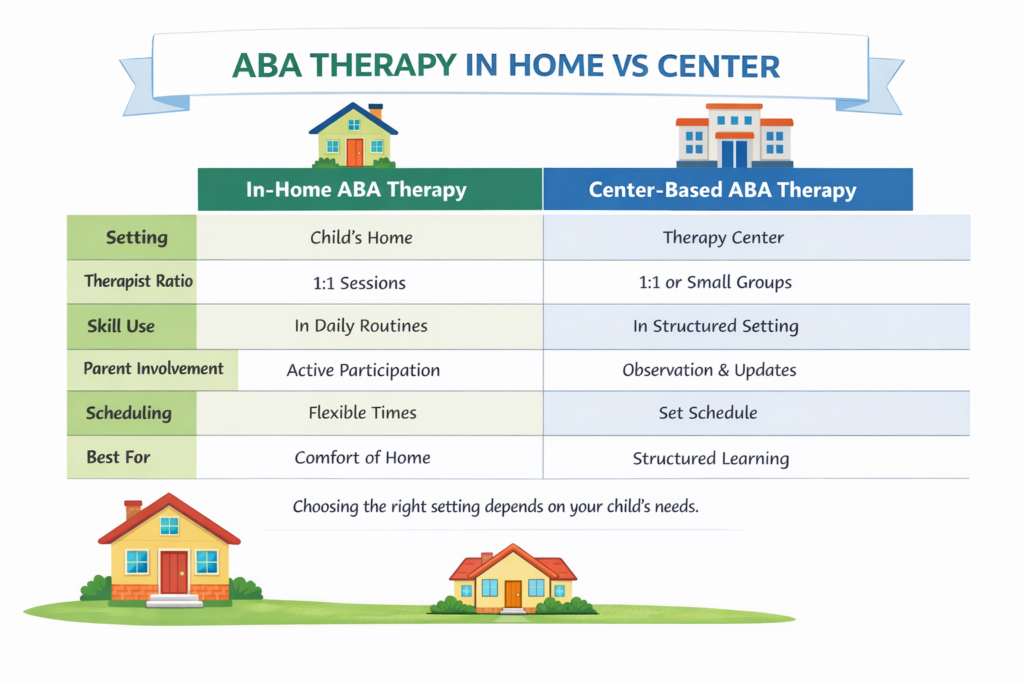
Differences between In-Home Based ABA Therapy and Center-Based
Key Benefits of Home-Based Autism Therapy for Children
Learning in a familiar environment reduces anxiety
Many children indeed feel more comfortable in familiar surroundings. By receiving autism therapy at home, this can reduce sensory overload and help children on the spectrum focus on their learning as opposed to adjusting to an unfamiliar clinic environment
Skills Learned at Home Generalize Faster to Real Life
When therapy takes place in a child’s home, they can practice skills in the environment where they’ll use them, such as during meals, playtime, or throughout their daily routines.
According to ABA therapy research, intensive ABA programs for autism that are delivered for 25-40 hours weekly over a period of one to three years can lead to significant improvements in a child’s language, intellectual functioning, and daily living skills. 3
Parents and caregivers are active partners in therapy
Another benefit of ABA therapy at home is the opportunity for collaboration between ABA therapists and families. With parents able to observe sessions, they can learn strategies and practice skills with their child throughout the day. It’s these types of collaborative opportunities that are often cited as a primary benefit of in-home therapy for autism, since children can receive consistent reinforcement across environments.
Why in-Home ABA Therapy Works Better for Some Children
How a Familiar Setting Reduces Barriers to Learning
Often, children on the spectrum who experience sensory processing differences or autism anxiety struggle to adapt to the busyness, including the noise, lights, and number of people, of a conventional therapeutic setting. That’s why learning in a familiar space removes many of these barriers and allows for the real therapy to begin.
Addressing Behaviors that Only Occur At Home
Some behaviors, such as resistance to bedtime, mealtime challenges, or sibling interactions, occur only in the home. That’s why ABA therapy in-home enables therapists to observe these situations directly and teach the necessary replacement skills when and where they’re needed most.
Why Skill Generalization Happens Faster in the Home Environment
When therapy occurs in situations where routines already exist, children are more likely to use their new skills outside structured sessions. This naturally supports skill generalization, a core goal of ABA therapy, where children learn to use skills consistently across different people, settings, and routines. For children receiving ABA therapy for autism, practicing communication, self-care, and social skills at home helps reinforce learning and encourages greater independence across multiple environments.
Is Home-Based Autism Therapy Right For Your Child?

Signs your child may thrive with in-home ABA therapy
Home-based ABA therapy for autism may be the most suitable option for your child if they:
- Experience autism anxiety in unfamiliar situations.
- Struggle with daily routines at home
- Benefit from individualized attention
- Require support practicing everyday life skills
When Center-Based Therapy Might Be A Better Fit
Some children do better working in structured clinical environments that provide regular interaction with other children and adults, as well as access to specialized equipment. Center-based therapy may be most suitable for children who function better with schedules and group learning opportunities.
What to Expect from Home-Based ABA Therapy Sessions
How Heartlinks Personalizes In-Home ABA Therapy Goals
Every child who receives home-based autism therapy at Heartlinks begins with a comprehensive assessment conducted by a BCBA therapist. This evaluation helps identify a child’s strengths, developmental goals, and specific challenges.
Based on this assessment, therapy goals are then individualized to address areas such as communication, social interaction, autism, emotional regulation, and daily living skills. Families often see meaningful progress when therapy is tailored to their child’s unique needs.
Sevda Hatipoglu shares her experience:
“We have an amazing therapist, Alayna, who has become a part of our family, and my son has excelled so much after she became his therapist.”
This kind of personalized support, combined with consistent collaboration between parents and therapists, helps children thrive not just during therapy sessions but in their everyday routines at home.
Typical Process at Home
The therapy process usually includes the following:
- An initial assessment and individualized treatment plan
- A certified ABA therapist conducts regular therapy sessions
- Ongoing supervision and oversight from a BCBA therapist.
- Parent coaching and instruction on ABA techniques to use at home.
- Data tracking and regular progress reviews
It’s this collaborative approach that helps to ensure children continue learning not only during therapy sessions but throughout their everyday environments.
Families can access Heartlinks’ services in multiple regions of the country, including ABA therapy in Charlotte, NC; ABA therapy in New Jersey; and ABA therapy in Atlanta, GA, thereby ensuring children and teens receive age-appropriate care tailored to their developmental needs.
If you’re ready to see how in-home ABA therapy could work for your child, take a moment and schedule a consultation with Heartlinks today.
Frequently Asked Questions About Home-Based Autism Therapy
- Does insurance cover home-based ABA therapy?
In a lot of cases, ABA therapy insurance coverage is considered medically necessary for a child diagnosed with autism. The extent of the coverage will depend on state mandates and the child’s family policy. That’s why it’s crucial to confirm benefits with their provider.
- Can I treat autism at home?
First off, autism is not something that can be ‘treated’ independently at home. Instead, these structured therapies, such as ABA, can be delivered in a home environment by trained professionals.
- What kind of training do parents receive?
Parents can receive a wide range of help, including coaching from therapists or the supervising BCBA therapist on strategies such as ABA positive reinforcement, communication prompting, and managing challenging behaviors.
- Is home-based therapy right for my child?
The best therapy setting depends on a child’s developmental needs, learning style, and family routine. Often, families find that a combination of home-based and center-based therapy provides the best balanced support.
- Can autism be treated at home?
Evidence-based interventions such as ABA therapy can be delivered successfully in home settings when implemented by a trained BCBA therapist.
- What are the benefits of ABA therapy at home?
The main advantages include individualized attention, parent involvement, flexible scheduling, and faster generalization of skills into daily routines.
- What are three primary reasons for seeking ABA services?
Families commonly pursue ABA services to improve autism communication skills, reduce challenging behaviors, and help children develop greater independence in everyday life.
- What is the hardest age for autism?
Every child develops differently, but early childhood, especially ages two through five, is often when autism-related challenges become more noticeable. Early intervention ABA during this stage can significantly improve developmental outcomes.
Resources
- Stephens, A. M., Briggs, A. M., Loder, B. H., Barr, J., & Miller, A. (2023). Delays to behavioral therapy in Michigan for children diagnosed with autism: A summary of needs assessment outcomes to inform public policy advocacy initiatives. Behavior Analysis in Practice. Advance online publication. https://pmc.ncbi.nlm.nih.gov/articles/PMC12209118/
- Gitimoghaddam, M., Chichkine, N., McArthur, L., Sangha, S. S., & Symington, V. (2022). Applied behavior analysis in children and youth with autism spectrum disorders: A scoping review. Perspectives on Behavior Science, 45(3), 521–557. https://doi.org/10.1007/s40614-022-00338-x
- Autism Speaks. (n.d.). Applied behavior analysis (ABA). https://www.autismspeaks.org/applied-behavior-analysis