

Whether it’s on television, in the movies, or on social media, the comparison of sociopath vs. autism is often made. Similar symptoms such as remorselessness, social challenges,
Inability to make personal connections, a sense of distance, and a lack of empathy are often exhibited with both diagnoses. However, despite these similarities, there exist some fundamental differences. Understanding these differences is not only important for reducing stigma but also critical for ensuring a child receives the right kind of support.
Keep reading as we clarify the most common misconceptions and break down the key differences between sociopathy and autism in real-world terms.
Why Sociopathy and Autism Are Often Confused
Overlapping Social Difficulties and Misunderstood Behaviors
On the surface, both sociopathy and autism exhibit similarities in social behavior, including the following:
- Difficulty maintaining eye contact
- Appearing emotionally absent
- Struggles with adhering to social norms
- Appearing indifferent in particular interactions
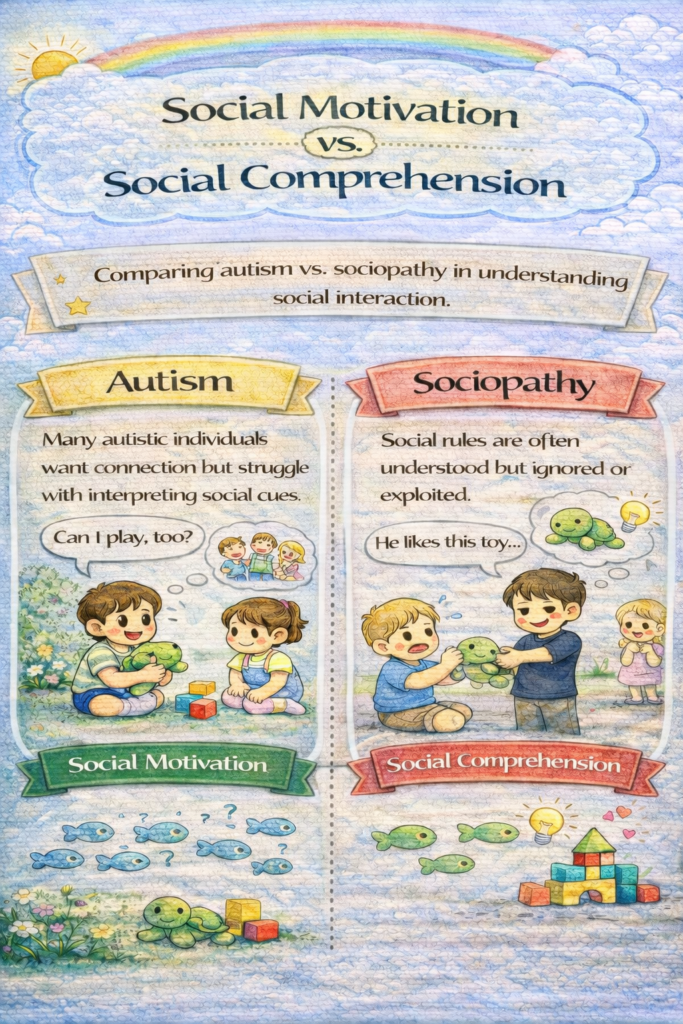
But those are where the similarities end, because the causes of these behaviors differ significantly. For example, many autistic children regularly experience challenges with social comprehension and often struggle with autism emotional regulation. This is particularly true in overwhelming environments.
Some children may also experience autistic anxiety, or difficulty interpreting social expectations, which can negatively impact their behavior.
By comparison, children with sociopathy may actively choose to disregard social rules even though they understand them.
How Misinformation and Media Stereotypes Fuel Confusion
The “emotionless geniuses” or the socially detached characters that are often portrayed in movies or on television are often labelled sociopathic or autistic, sometimes even interchangeably. However, these portrayals are frequently inaccurate because they blur the distinctions between the two diagnoses and reinforce the misconception that anyone with autism is unsympathetic or lacks moral awareness.
The truth is that autism spectrum disorder is a neurodevelopmental condition, and in comparison, sociopathy references a personality disorder that’s characterized by an ongoing disregard for others’ rights. Confusing the two not only spreads misinformation. It can also stigmatize a child, resulting in delayed intervention for children who need developmental support, such as ABA programs for autism.
What is Sociopathy (Antisocial Personality Disorder)
Defining Sociopathy and Its Core Personality Traits
The term sociopathy is most often used to describe Antisocial Personality Disorder (ASPD). The National Institute of Mental Health defines ASPD1 as a pattern of disregard for others’ rights, often involving manipulation, impulsivity, and a lack of remorse, with symptoms typically emerging in adolescence or early adulthood. This is very different from autism, where families often seek early support through structured ABA therapy.
ASPD is defined by the following:
- Ongoing disregard for laws and social norms
- Manipulation or deceitfulness
- Impulsivity
- Aggression
- A complete lack of remorse for or after harming others
Traditionally, ASPD is diagnosed in adulthood and is usually preceded by a noticeable pattern of conduct or behaviorally related issues that began in that person’s childhood or adolescence.
Empathy, Morality, and Behavior in Sociopathy
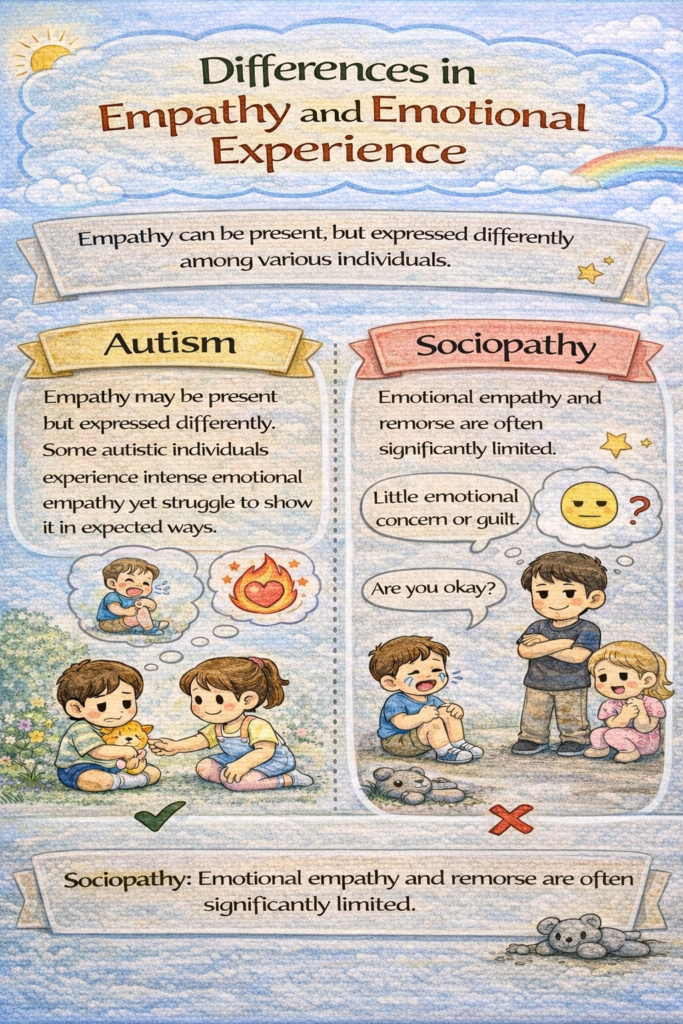
Intellectually, people with ASPD may understand others’ emotions, but they often fail to demonstrate emotion, remorse, or empathy. Often, they deliberately engage in harmful behaviors and consciously break social rules and norms.
This is in stark contrast to autism, where misunderstandings often occur due to differences in processing social information, rather than intentional disregard.
How Sociopath is Diagnosed and Managed
An official diagnosis of ASPD requires a comprehensive psychological evaluation by a licensed mental health professional. Once that’s accomplished, treatment may involve psychotherapy focused on behavior regulation and accountability.
Whereas autism is a neurodevelopmental condition that’s present from early childhood and is typically identified through diagnostic testing for autism, ASPD is usually diagnosed much later in a person’s life.
What is Autism Spectrum Disorder (ASD)?
Key Characteristics and Cognitive Patterns in Autism
Autism spectrum disorder is characterized as a lifelong neurodevelopmental condition that can affect a wide range of a person’s skills, including communication, sensory processing, and social interaction. According to the Centers for Disease Control and Prevention2 and the National Institute of Mental Health3, autism begins in early childhood. It reflects differences in brain development that affect how individuals perceive and interact with the world, which is why early identification and appropriate ABA programs for autism can play such a critical role in long-term development.
Core characteristics may include:
- Differences in verbal and nonverbal communication (including nonverbal autism)
- Repetitive behaviors or focused interests
- Preference and adherence to routine and predictability
- Sensory sensitivities and sensory processing differences
Autism is described as a spectrum disorder because it presents differently in every individual.
How Autism Influences Communication and Social Interaction
Autistic individuals may:
- Interpret language in a literal way
- Misunderstand or completely overlook social cues
- Struggle to understand different perspectives
- Quickly feel overwhelmed in group settings
Challenges may include difficulty with autism communication or navigating subtle nonverbal cues.
Rather than originating from a desire to harm or manipulate others, the above-mentioned challenges typically stem from neurological differences in social processing.
Autism Strengths and the Neurodiversity Perspective
The emphasis of the neurodiversity movement is to view autism as a difference, as opposed to a defect. Many autistic individuals demonstrate:
- Unrivaled pattern recognition
- Singular focus in very specific areas of interest
- Honesty and almost unfiltered direct communication
- A strong sense of justice and fairness.
Understanding a child’s strengths alongside their challenges enables a family to actively support therapeutic interventions such as ABA therapy, social skills therapy, or other individualized developmental supports.
Sociopath vs. Autistic: Key Differences Explained
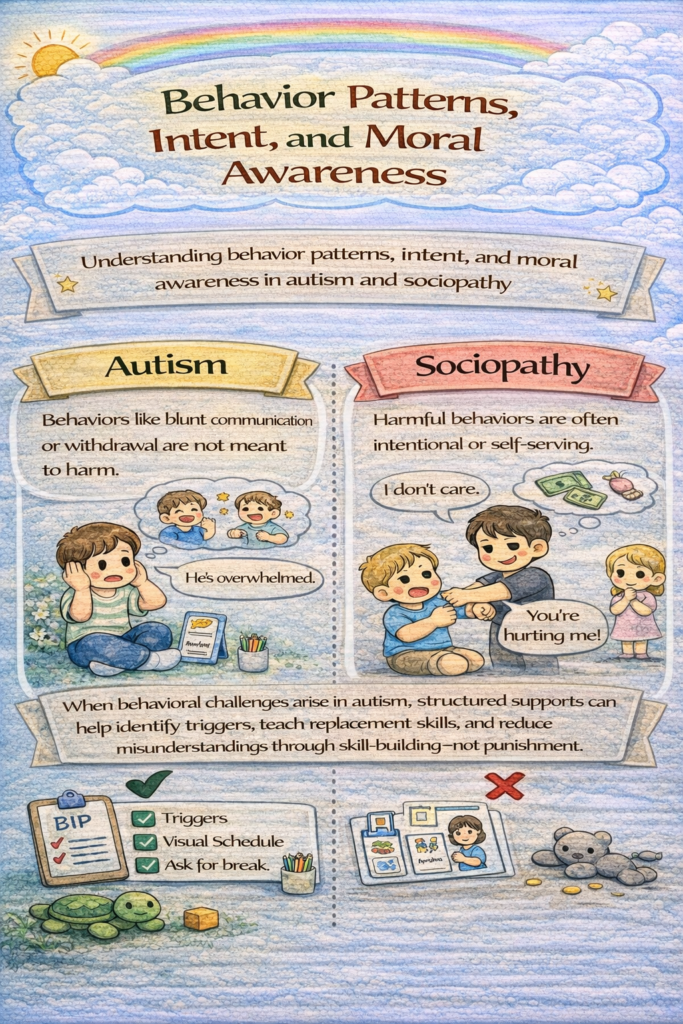
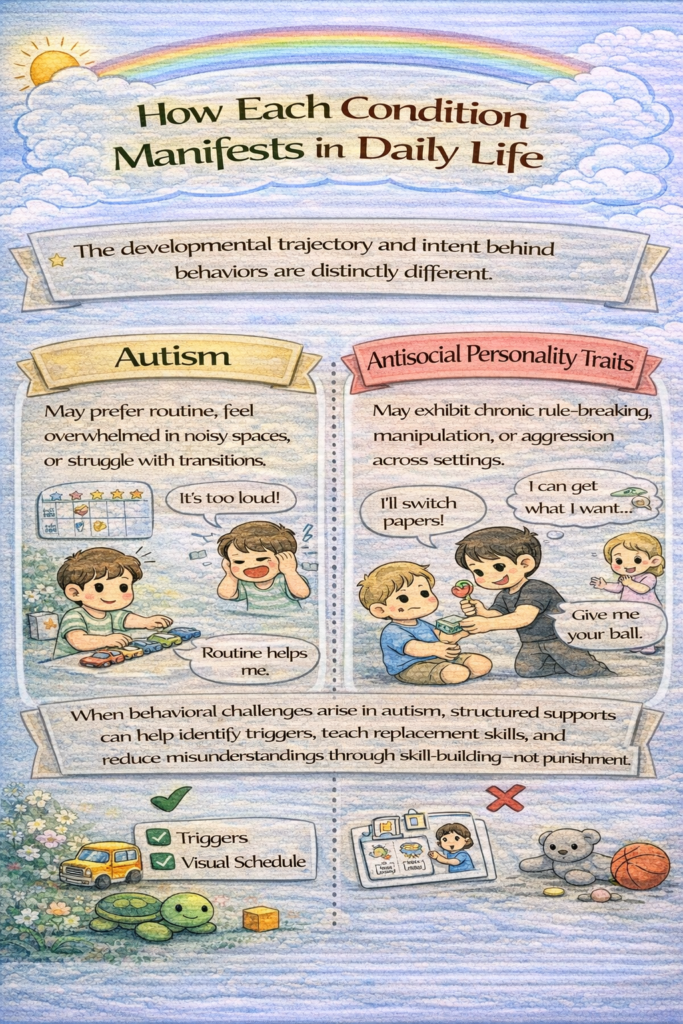
Can Autism Be Mistaken For Sociopathy?
Why Some Social Behaviors Are Misinterpreted
From flat facial expressions and limited eye contact to incredibly blunt speech, several autistic characteristics can be misinterpreted. In autism, these behaviors are frequently linked to sensory overload, autism anxiety, or differences in nonverbal communication as opposed to a complete lack of care.
The Importance of Context and Comprehensive Evaluation
Above all, context matters when trying to obtain a proper diagnosis of autism. A trained medical professional must evaluate a child’s developmental history, communication patterns, emotional responses, and long-term behavior before making an official diagnosis.
How Clinicians Differentiate Autism from Personality Disorders
Professionals look at a range of symptoms, including the following:
- Age of symptom onset
- Motivation behind a person’s behavior
- When harmed, what is their emotional response
- Patterns of social learning
- Neurological developmental history
A full developmental assessment allows a professional to ensure that an autistic individual is not mischaracterized.
How ABA Therapy Supports Social and Emotional Growth in Autism
Building Communication and Emotional Understanding
Incorporating evidence-based ABA therapy can help children on the spectrum develop autism communication, emotional awareness, and functional life skills. To focus and ensure meaningful growth, programs are customized to the child’s strengths and weaknesses.
A variety of approaches may include functional communication training, structured teaching, and ABA positive reinforcement strategies. In situations where behaviors significantly interfere with learning or safety, a structured Behavior Intervention Plan or bip in ABA may also be developed to identify triggers, teach replacement skills, and reduce harmful behaviors in measurable ways.
Using ABA Therapy to Strengthen Social Skills Without Masking Identity
The focus of modern ABA is skill-building while respecting each person’s individuality. The goal is not to suppress a child’s autistic traits. Instead, it’s to provide them with the skills to support their independence, safety, and authentic connection.
Some of the interventions may include NET in ABA and task analysis ABA.
Collaboration Between Families and Therapists
Family involvement is crucial during ABA therapy for an autistic child. A qualified BCBA therapist can coach caregivers to reinforce social-emotional skills across environments, thereby encouraging generalization and long-term success.
Often, families also explore ABA in-home therapy or learn ABA therapy at home techniques and skills to ensure consistency.
When and How to Seek Professional Evaluation and Support with Heartlinks
Working with Qualified Clinicians (BCBA)
As a parent or caregiver, if you notice that your child is dealing with ongoing social challenges, difficulties with emotional regulation, or communication delays, talk to your pediatrician or developmental specialist. A BCBA therapist can conduct a structured assessment and design an individualized intervention plan, but usually a doctor’s referral is required.
Getting a Proper Diagnosis and Individualized Support
The earlier and more accurate a diagnosis, the more appropriate services your child will receive. When mislabeling behaviors, particularly in the case of sociopath vs. autism, this can delay significant support for your child. A thorough developmental evaluation can protect them against societal stigma and can enable them to receive targeted intervention.
Supporting Your Child’s Social and Emotional Growth
Understanding the difference between sociopath vs. autism is about more than just knowing what each label means. Parents must understand that an accurate diagnosis means their child will be seen accurately, supported appropriately, and guided with compassion rooted in evidence-based ABA therapy. Families can forge a clear path rather than confusion and stigma when they understand their child’s social challenges in the context of accurate developmental understanding.
If you are concerned about your child’s social development, emotional regulation, or communication skills, contact Heartlinks to schedule a consultation and learn more about customizable autism support.
With early, informed intervention, your child can benefit from lasting, meaningful therapy.
Heartlinks offers services in multiple locations, including the following:
Frequently Asked Questions About Sociopathy and Autism
- Can autism be mistaken for sociopathy?
Yes, particularly when social differences are misunderstood. However, a comprehensive evaluation can clearly distinguish developmental differences from those of personality disorders.
- What are the biggest behavioral differences between sociopaths and autistic people?
The biggest differences involve intent, empathy, and moral awareness. Autism reflects social processing differences, while sociopathy involves a persistent disregard for others’ rights.
- How does autism affect empathy and relationships?
Autistic individuals can experience empathy deeply, but often it’s expressed differently. Relationship challenges typically stem from communication gaps, not due to a lack of care.
- Is there any overlap between autism and antisocial personality disorder?
No. They are separate diagnoses with different developmental paths. While any individual can display complex traits, autism itself does not cause antisocial behavior.
- Can ABA therapy improve social awareness in autistic individuals?
Absolutely! Structured ABA programs can teach perspective-taking, communication, and emotional recognition in ways that support authentic social growth. If you’re looking for more information on autism and ABA therapy, reach out to Heartlinks today.
Resources
- National Institute of Mental Health. (2024, December). Autism spectrum disorder (ASD). U.S. Department of Health and Human Services, National Institutes of Health. https://www.nimh.nih.gov/health/topics/autism-spectrum-disorders-asd
- Centers for Disease Control and Prevention. (2024, May 16). Signs and symptoms of autism spectrum disorder (ASD). U.S. Department of Health & Human Services. https://www.cdc.gov/autism/signs-symptoms/index.html
- U.S. National Library of Medicine. (2024, July 17). Antisocial personality disorder. MedlinePlus. https://medlineplus.gov/ency/article/000921.htm