


To become a BCBA therapist in Georgia, you must earn a master’s degree in behavior analysis or a related field, complete a BACB-approved course sequence, accumulate at least 1,500 hours of supervised fieldwork, pass the BCBA examination, and apply for Georgia state licensure through the Georgia Secretary of State Behavior Analyst Licensing Board 1.
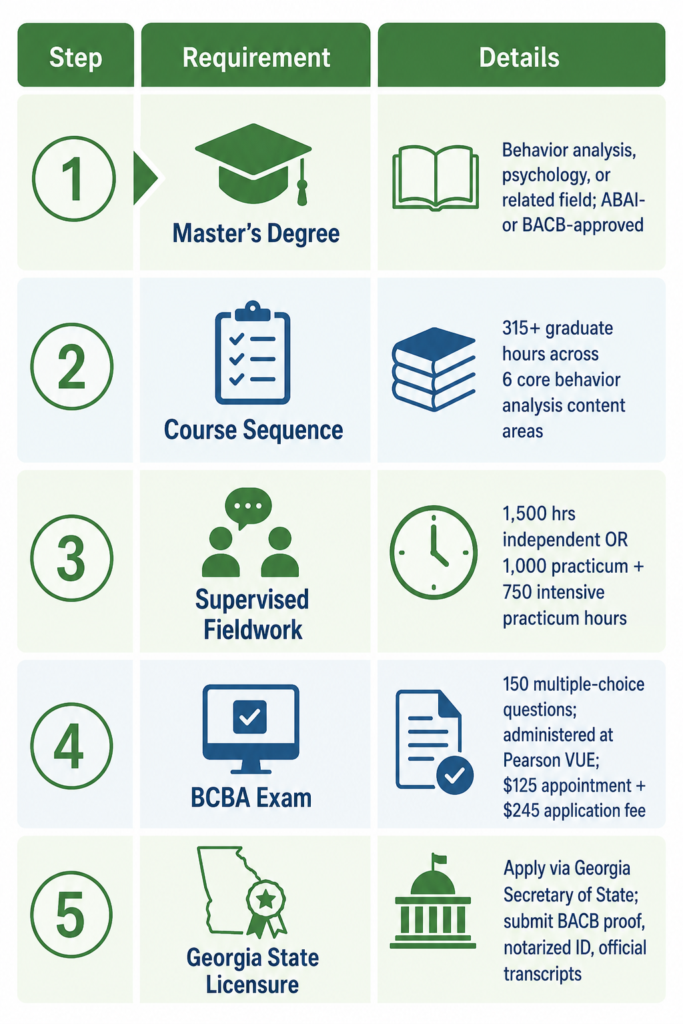
Step 1: Earn a Qualifying Master’s Degree
The first step in becoming a BCBA therapist in Georgia is earning a qualifying master’s degree. The Behavior Analyst Certification Board (BACB) requires candidates to hold a graduate degree in behavior analysis, psychology, education, or a related field that includes approved behavior analysis coursework.
Often, students begin their journey by enrolling in an ABA master’s degree Georgia program that’s designed to meet BCBA certification requirements while preparing them for clinical practice. Selecting the right graduate program can help students streamline their path toward becoming a licensed BCBA in Georgia.
Accreditation Requirements: ABAI vs. BACB-Approved Programs
When evaluating ABA master’s degree Georgia programs, it’s important to understand the difference between ABAI accreditation and BACB-approved coursework.
ABAI-accredited programs have undergone a thorough review process to ensure that they meet the required standard in behavior analysis education. It’s important to note that other universities may offer BACB-approved course sequences that satisfy certification requirements, even if the program itself is not ABAI-accredited.
Before enrolling, make sure the program meets the current BACB BCBA certification requirements in Georgia and qualifies graduates to sit for the BCBA examination.
Georgia Universities with Approved ABA Programs
Several universities in Georgia offer behavior analysis programs that can help students meet the requirements for BCBA certification. Those institutions include the following:
- Georgia State University
- University of Georgia (UGA)
- Georgia Southern University
- Columbus State University (including online options)
Not sure if BCBA is the right fit? Explore what a certified ABA therapist actually does day-to-day before you choose your program.
Step 2: Complete Supervised Fieldwork Hours
Once your fieldwork is complete, the next step is to accumulate supervised fieldwork experience. The supervised fieldwork BCBA requirements are designed to ensure that candidates can apply their learned behavior-analytic principles in real-world settings.
Participating in fieldwork allows future behavior analysts to gain valuable hands-on experience while receiving mentorship from qualified supervisors. Depending on the pathway selected, some students may complete a BCBA practicum Georgia through their university or an approved ABA provider, helping them build clinical skills while working towards certification.
How many hours are required?
According to the BCBA certification Georgia guidelines, candidates must complete:
- 1,500 hours of independent supervised fieldwork or
- 1,000 practicum hours plus 750 intensive practicum hours
Fieldwork experiences can be completed in several different ways, including the following:
- ABA Clinics
- Schools
- Community-based programs
- Early intervention settings
- In-home ABA services
These experiences can help students prepare for the responsibilities associated with holding a BCBA Georgia license.
See what a BCBA career path looks like at Heartlinks that includes RBT and BCBA and beyond.
How to Find a BCBA Supervisor In Georgia
One of the most important parts of the BCBA certification process is finding a qualified supervisor.
Potential supervision opportunities may be available through several different avenues, including the following:
- An ABA therapy provider
- Public school districts
- University practicum placements
- Autism treatment centers
- Professional behavior analysis organizations
Many aspiring BCBAs start their careers as Registered Behavior Technicians (RBTs), which often allows for access to supervision opportunities and much-needed hands-on clinical experience.
As one Heartlinks BCBA says:
“I have been working for Heartlinks for 2+ years now and find it very organized and structured with timely support for everyone from client to BCBA. Management is responsive in communication and providing good matches based on schedule and location…..There are always opportunities to learn something new or receive support.”
Still deciding which credential is right for you? Explore BCaBA vs. BCBA; What’s the difference?
Step 3: Pass the BCBA Examination

Once you’ve completed your education and supervised experience requirements, the next step is passing the BCBA exam. For many candidates, preparing for the BACB exam and Georgia requirements is one of the most crucial milestones on the certification path.
The BCBA exam evaluates competency across key domains of behavior analysis and is a requirement for BCBA certification in Georgia. Successfully passing the exam automatically demonstrates that candidates possess the knowledge and skills needed to practice the highly technical behavioral analysis effectively and ethically.
Exam Format and Pass Rates
The BCBA exam consists of the following:
- 150 multiple-choice questions
- Computer-based testing through Pearson VUE
- Questions covering a range of topics, including ethics, assessment, behavior reduction, skill acquisition, supervision, and measurement.
According to BACB reporting, the national first-time pass rate was approximately 54% in 2024.
Because the exam is so comprehensive, it’s recommended that candidates start preparing several months before their test is scheduled.
Study Tips and Prep Resources
Traditionally, the most successful candidates prepare by doing either some of or all of the following:
- Reviewing the BCBA task list
- Taking practice examinations
- Participating in study groups
- Using BCBA exam prep courses
- Creating structured study schedules
Curious what comes after the exam? See what a BCBA career path looks like at Heartlinks.
Step 4: Apply for Georgia State Licensure
Passing the BCBA exam is not the final step. Rather, professionals must obtain a Georgia BCBA license before practicing behavior analysis in the state. Earning a license ensures that behavior analysts meet all state requirements and maintain their national certification.
The Georgia Behavior Analyst Licensing Board oversees licensure requirements, application reviews, renewals, and professional practice standards for behavior analysts throughout the state of Georgia. Applicants seeking a Georgia BCBA license must submit all required documentation and obtain approval from the board before providing services independently.
What the Georgia Licensure Application Requires
Applicants seeking Georgia BCBA licensure generally must submit the following:
- Proof of BCBA certification
- Notarized citizenship verification
- Official transcripts
- Completed application forms
- Applicable licensing fees
The Georgia Behavior Analyst Licensing Board reviews all applications before granting licensure. Applicants should ensure that all required documentation, including proof of BACB certification, notarized citizenship verification, and transcripts, is complete and accurate to avoid delays in the licensing process.
Licensure Deadlines and Renewal Notices
Behavior analysts must maintain current BACB certification and Georgia licensure 2.
According to current guidance, renewal fees have been waived through August 31, 2027. Yet, applicants should always verify current requirements with the Georgia Behavior Analyst before applying or renewing.
Ready to put your license to work? Explore open BCBA positions at Heartlinks ABA across Georgia.
BCBA Salary and Job Outlook in Georgia
Many professionals are researching how to become a BCBA in Georgia and also compare BCBA salary by state when evaluating career opportunities. Understanding the typical BCBA salary Georgia employers offer can help prospective behavior analysts evaluate the return on their educational investment and career opportunities.
The demand for behavior analysts continues to grow as an increasing number of families seek autism services particularly through Ava’s Law and autism insurance in Georgia. It’s this increasing demand that’s contributed to strong job prospects for licensed behavior analysts across Georgia.
Explore our RBT and BCBA career path at Heartlinks, and see what your journey from RBT to BCBA and beyond can look like.
Average BCBA Salary by City
Many professionals are currently researching how to become a BCBA in Georgia while also seeking information on BCBA salary trends and career opportunities. According to recent market data, the average BCBA salary in Georgia is approximately $94,000 per year, though compensation varies widely depending on the candidate’s experience, employer, and location.
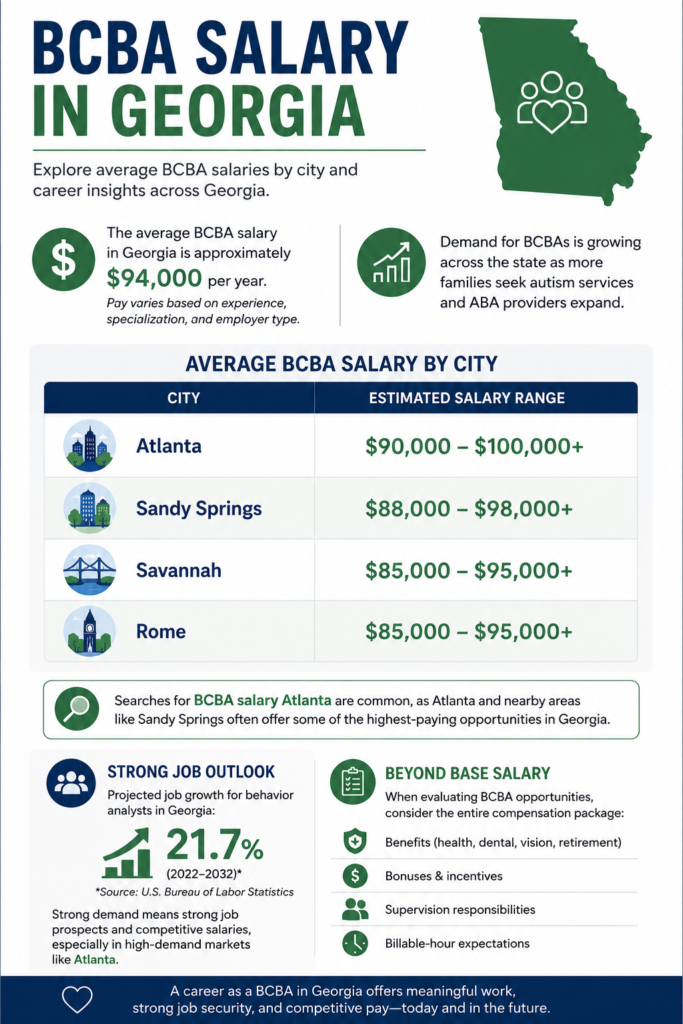
Searches for BCBA salaries in Atlanta are especially common, as the city and surrounding areas, such as Sandy Springs, frequently offer some of the state’s highest-paying opportunities. Savannah and Rome also continue to see growing demand as ABA providers expand services throughout the state.
It’s important to remember that when comparing BCBA positions, consider the full compensation package, including benefits, bonuses, supervision responsibilities, and billable-hour expectations.
Georgia’s Growing Demand for BCBAs
The demand for behavior analysts continues to rise across Georgia as more families seek autism services and ABA providers expand statewide. With an estimated job growth of 21.7% between 2022 and 2032, BCBAs can expect stronger career prospects and competitive salaries. This is particularly true in major metro areas, where BCBA salary Atlanta rates are often among the highest in the state.
Start Your BCBA Career in Georgia Today
If you’re wondering how to become a BCBA in Georgia, the process involves earning a qualifying master’s degree, completing supervised fieldwork, passing the BCBA examination, and obtaining state licensure.
While the journey requires dedication and advanced education, the reward is a meaningful career helping individuals develop critical life skills and achieve greater independence.
Whether you’re a current RBT, a graduate student, or someone considering a career change, now is an excellent time to pursue BCBA certification in Georgia and begin building a rewarding future in behavior analysis.
Why Heartlinks? Listen to what one Georgia BCBA therapist had to say:
“This is the best ABA company I have ever worked for as a BCBA. I truly love the company and all the administrative staff. They really care about the families and their employees. I do not plan on going anywhere.”
See what a BCBA career path looks like at Heartlinks, from RBT to BCBA and beyond.
Frequently Asked Questions About Becoming a BCBA in Georgia
What degree do I need to become a BCBA in Georgia?
You need to have a master’s degree in behavior analysis, psychology, education, or a related field from an accredited institution.
How many supervised hours are required for BCBA certification?
You are required to have either 2,000 hours, including 5% supervision, or 1,500 hours with 10% supervision. All of this needs to be completed within 5 consecutive years.
Do I need a Georgia state license in addition to BCBA certification?
Yes! In addition to a BCBA certification, you must obtain a license from the Georgia Behavior Analyst Licensing Board.
How much do BCBAs earn in Georgia?
On average, BCBAs earn $75,214 per year. The typical range is $52,000-$83,000, where the cities of Atlanta and Savannah pay significantly more.
Can I transfer my BCBA license from another state to Georgia?
Absolutely! You can transfer your BCBA license from another state. All you have to do is request that the former state licensing board send official verification of your license directly to the Georgia Behavior Analyst Licensing Board.
Resources
- Georgia Secretary of State. Georgia Behavior Analyst Licensing Board. https://sos.ga.gov/georgia-behavior-analyst-licensing-board
- Behavior Analyst Certification Board. (n.d.). Board Certified Behavior Analysts (BCBA). https://www.bacb.com/bcba/