

When comparing ocd vs. autism, people often notice that both conditions feature repetitive and restrictive behaviors, strict routines, and sensory processing differences. Yet the reasons behind these behaviors are very different. About ocd and autism, repetitive actions may look similar on the surface, but OCD, or obsessive-compulsive disorder, is usually driven by anxiety and fear. By comparison, autism-related behaviors such as repetitive actions are often linked to comfort, predictability, or autism sensory regulation. This article explains the key differences where OCD and autism overlap, how they can occur together, and what treatment approaches are most effective.
What is the Core Difference Between OCD and Autism
Although the focus of ocd vs. autism often centers around repetitive and restrictive behaviors, the most important distinction is what motivates those behaviors.
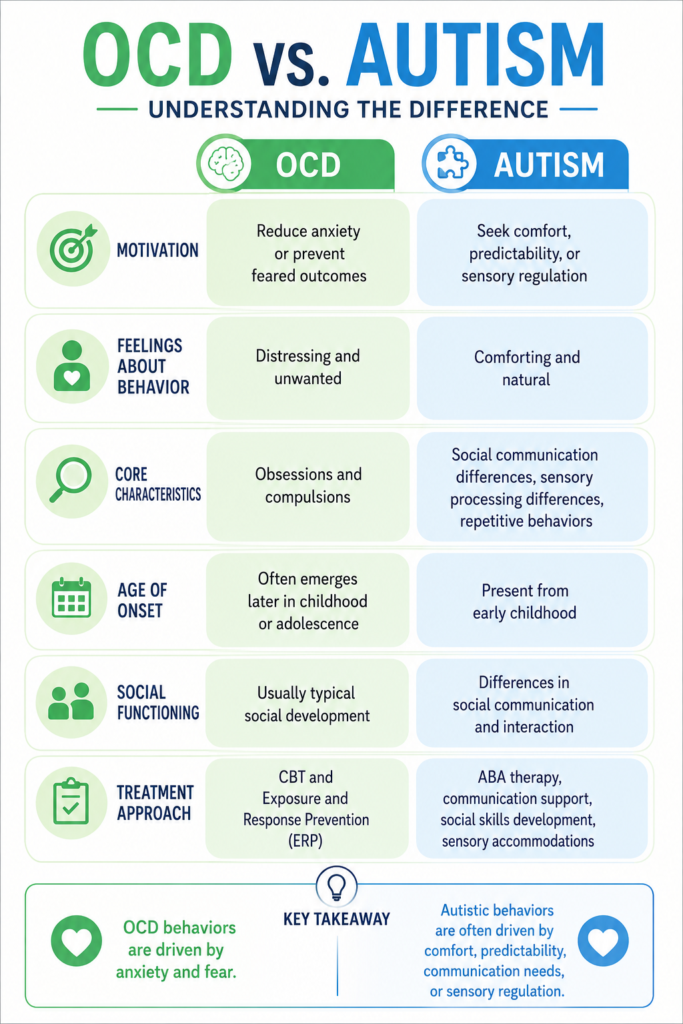
Ego-dystonic (OCD): The thoughts and compulsions feel unwanted, distressing, and invasive.
Ego-syntonic (Autism): The routines and stimming feel natural, pleasurable, and comforting.
Understanding this distinction is often the key to accurately identifying OCD and autism.
Motivation-fear-driven compulsions vs. comfort-seeking routines
Children with OCD will often check locks, wash their hands till they’re raw, or constantly seek reassurance because they fear something bad or untoward could happen if they do not complete the behavior.
In contrast, autistic children usually do best when following routines because they provide structure, predictability, and comfort. A child on the spectrum may insist on taking the same route to school or eating the same foods prepared in a certain way because this type of regularity supports autism emotional regulation and helps them meet their sensory needs. Some children may also engage in sensory-seeking behaviors, such as autism spinning, autism hand flapping, autism finger flicking, or other forms of stimming that provide calming sensory input.
Understanding the motivation behind your child’s repetitive behavior is often more important than the behavior itself. Determining whether the behavior is driven by fear or by a need for comfort, routine, or autism sensory regulation can help clinicians distinguish between OCD and autism.
Feelings about the behavior: ego-dystonic vs. ego-syntonic
Often, a child with OCD will feel extremely trapped by their compulsions. Sure, they may understand that the behavior is excessive, but they are unable to stop it.
By comparison, autistic children generally do not experience these feelings. Their preferred routines usually provide a feeling of comfort, helpfulness, or joy rather than being intrusive.
The difference is that one of the most reliable ways to distinguish between OCD vs. autism is through an official clinical diagnosis.
Repetitive Behaviors vs. Compulsions- How to Tell Them Apart
Both conditions involve repetition, yet their purposes are vastly different.
For example, a child diagnosed with OCD may repeatedly touch a doorknob because they believe it prevents harm to themselves or the people they love. An autistic child may engage in repetitive movements or autistic stimming behaviors, such as rocking, hand flapping, or finger flicking, because they provide much-needed sensory input, emotional regulation, or simply pure enjoyment.
Many autistic children also display repetitive and restrictive behaviors that are tied to their interests, routines, or sensory preferences rather than fears. In some cases, behaviors that appear oppositional may actually be related to sensory overload, communication challenges, or autistic defiance, rather than intentional noncompliance.
Frequently, clinicians use evidence-based approaches, such as ABA therapy and other applied behavior analysis interventions, to better understand why a behavior occurs and to identify appropriate supports. Interventions may include functional communication training, social stories ABA, social skills ABA, therapy for social skills, and ABA positive reinforcement strategies designed to build coping skills and independence.
Where OCD and Autism Overlap
The similarities between OCD and autism can sometimes make diagnosis challenging.
Shared Behaviors that cause diagnostic confusion
Both conditions may involve:
Because these behaviors can look similar, parents sometimes struggle to determine whether they’re observing OCD, autism, or both.
Sensory sensitivities in both conditions
Both autistic individuals and people with OCD can experience significant sensory challenges. Children with either diagnosis may become distressed by autism loud noises, certain textures, bright lights, or crowded environments. Others may engage in sensory seeking activities because they’re understimulated in autism presentations or need additional sensory regulation.
Common examples include covering ears, seeking movement through spinning, or displaying other sensory-seeking behaviors. Understanding the difference between sensory or behavior concerns is important because the intervention approach may differ tremendously.
Professionals such as an occupational therapist for autism can help families identify the sensory processing differences as they relate to autism vs. OCD.
Can OCD be mistaken for autism?
Absolutely! OCD is frequently misdiagnosed as autism. This is particularly true in children who display rigid routines, social difficulties, repetitive behaviors, or high levels of anxiety.
That’s why a comprehensive diagnosis of autism can help distinguish between the two conditions. A trained specialist can determine whether your child’s symptoms align with historical diagnostic categories such as asperger’s syndrome, pervasive developmental disorder not otherwise specified, or childhood disintegrative disorder. However, these diagnoses are no longer used under current diagnostic criteria.
Do work that matters-join a team that gives you the flexibility, support, and competitive pay you deserve. View open BCBA career positions.
Can you have both OCD and Autism?
How common is OCD and Autism Co-Occurrence?
Research suggests that OCD occurs more frequently in autistic individuals than in the general population1. While the exact prevalence does tend to vary across studies, clinicians increasingly recognize the overlap between autism and obsessive-compulsive symptoms.
Children with high functioning autism traits may be particularly difficult to assess because repetitive behaviors can resemble compulsions.
Why Accurate Diagnosis Matters When Both Are Present
When OCD and autism co-occur, treatment planning becomes significantly more complex. A child who struggles with autistic anxiety, emotional dysregulation in autism, or communication challenges may require an entirely different approach than one who has OCD alone.
Receiving an accurate diagnosis will help providers determine whether behaviors are related to compulsions, sensory seeking autism, communication barriers, or autism emotional regulation difficulties.
How Treatment Must Be Adapted When The Conditions Co-Occur
Effective treatment should address both conditions simultaneously. For example, a child may benefit from OCD treatment while at the same time receiving support for autism communication, social development, sensory needs, and functional communication training.
A trained BCBA therapist might combine cognitive-behavioral strategies with autism-specific supports such as social stories ABA, therapy for social skills ABA, or social skills for high functioning autism.
How are OCD and Autism Treated Differently?
OCD Treatment-CBT and Exposure and Response Prevention (ERP)
ERP and cognitive behavioral therapy have taken the place as the gold standard treatments for OCD. These combined approaches help children and adults with the disorder gradually face fears without engaging in compulsive behaviors.
Autism Treatment-ABA Therapy, Communication, and Sensory Support
Unlike OCD treatment, autism interventions are focused on skill building, communication, quality of life, and the child’s overall independence.
Common supports may include but are not limited to the following:
Families often report meaningful progress when treatment is individualized and delivered consistently across settings, such as parent Terese B.
“If I could leave 10 stars, I would! We chose in-home ABA therapy because our son struggled to connect with providers outside the home. Being involved in the learning process has made a huge difference. At just 3½ years old, he’s learning new skills every week, and the support from the Heartlinks team has been incredible.”
Why Treating One Without Addressing The Other Can Cause Harm
Treating autism and OCD in isolation can cause harm mainly because the two conditions share overlapping traits such as repetitive behaviors and a need for routine. In the event a therapist fails to address or misinterprets both disorders, this can lead to tremendously ineffective therapies, untreated anxiety, or even the inappropriate removal of essential self-soothing autistic coping mechanisms.
The danger in treating only one condition arises from several critical factors:
1. Opposing Motivations for Repetitive Behaviors
2. Risks of Standard OCD Therapy
3. Risks of a Misdiagnosis and Wrong Interventions
How Heartlinks ABA Supports Children with Autism-Including When OCD Is Also Present

With OCD and autism sharing similar traits, getting the correct diagnosis and support is crucial. At Heartlinks ABA, our board-certified behavior analysts build individualized programs based on each child’s strengths, needs, communication and skill levels, and behavioral goals.
Whether your child has autism, OCD, or both, our team is committed to helping them build the skills they need to thrive.
As one Heartlinks parent, Heather says:
“Our 2-year-old son is nonverbal, and after just one week with Heartlinks ABA, he was able to say ‘open’ for the first time. We were amazed by the progress and grateful for the support of his therapy team. It gave us hope for what the future could hold.”
With locations in the following areas:
- ABA Charlotte NC
- ABA therapy New Jersey
- ABA therapy Atlanta GA
- ABA therapy Indiana
- ABA therapy in Baltimore, Maryland
Heartlinks has a location and a plan that will work for your child.
If your child has an autism diagnosis-or you’re trying to understand what you’re seeing- Heartlinks ABA can help clarify the picture and build an individualized plan. Contact us today.
Frequently Asked Questions About OCD vs. Autism
Is OCD a form of autism?
No! OCD and autism are completely separate conditions, though they share similar traits.
Can OCD be mistaken for autism?
Absolutely! With similar symptoms like repetitive behaviors, anxiety, adhering to strict routines and avoidance behaviors, this can certainly create diagnostic confusion.
Can people with OCD have sensory issues?
Yes they can. Even though sensory challenges are more often associated with autism, people with OCD can have them too.
Is OCD a neurodiversity?
Though many advocates consider OCD a neurodiversity, medically speaking it is not.
Does autism cause OCD?
Absolutely not! Autism does not cause OCD.
What is the difference between autistic stimming and OCD compulsions?
Autistic stimming examples including hand flapping, finger flicking or spinning usually provide comfort. By comparison, OCD compulsions are usually performed to reduce anxiety.
Understanding whether your child is dealing with autism, OCD, or both is the first step. Heartlinks ABA is here to help. Reach out today.
Resources
- Martin, A. F., Jassi, A., Cullen, A. E., Broadbent, M., Downs, J., & Krebs, G. (2020). Co-occurring obsessive–compulsive disorder and autism spectrum disorder in young people: Prevalence, clinical characteristics and outcomes. European Child & Adolescent Psychiatry, 29(11), 1603–1611. https://doi.org/10.1007/s00787-020-01478-8