


When a reward follows a child’s action, it’s more likely to be repeated. By comparison, if a punishment follows that same action, it’s avoided. This is the foundation of operant conditioning in ABA, a type of learning in which an autistic child’s behavior is shaped by its consequences. It’s a foundational tool in the ABA therapy arsenal, in which behavior is changed through reinforcement and punishment.
For children with autism, this approach plays a critical role in teaching communication, daily living skills, and emotional regulation, and it is commonly implemented by a BCBA therapist overseeing an individualized treatment plan.
For families who are trying to learn about available autism services, understanding how operant conditioning works can provide them with confidence, reassurance, and clarity. In essence, it can show them that behavior support can be purposeful, ethical, and customized to their child’s needs.
What Operant Conditioning Means in ABA Therapy
Operant conditioning ABA refers to a learning framework used in ABA therapy that explains how, in response to consequences, a child’s behavior may change. Unlike focusing exclusively on internal motivation, operant conditioning examines observable behavior and how outcomes influence future actions. It is foundational across many evidence-based ABA programs for autism and can support children across the autism spectrum.
How Consequences Shape Learning
Children on the spectrum, like all kids, learn from the consequences of their actions. When a behavior leads to a meaningful outcome, the likelihood of it occurring again increases. When it does not achieve its intended effect, the behavior often decreases over time.
It’s this cause-and-effect relationship that’s central to reinforcement in ABA, where therapists intentionally design consequences that support learning while remaining compassionate and developmentally appropriate.
Why Operant Conditioning Supports Children with Autism
Children on the autism spectrum often fare best in predictable, consistent learning environments. Operant conditioning can help reduce a child’s anxiety by clarifying expectations and outcomes, particularly for children who are prone to autism anxiety or emotional dysregulation. It’s this structured approach that has consistently proven effective across age groups, including adolescents receiving ABA therapy for older kids.
The Difference between Respondent and Operant Conditioning
When comparing respondent and operant conditioning, it’s important to note that respondent conditioning involves involuntary responses, whereas operant conditioning focuses on learned behaviors shaped by consequences. Because its focus is on functional and teachable skills, ABA therapy emphasizes operant conditioning rather than respondent conditioning.
The 4 Quadrants of Operant Conditioning
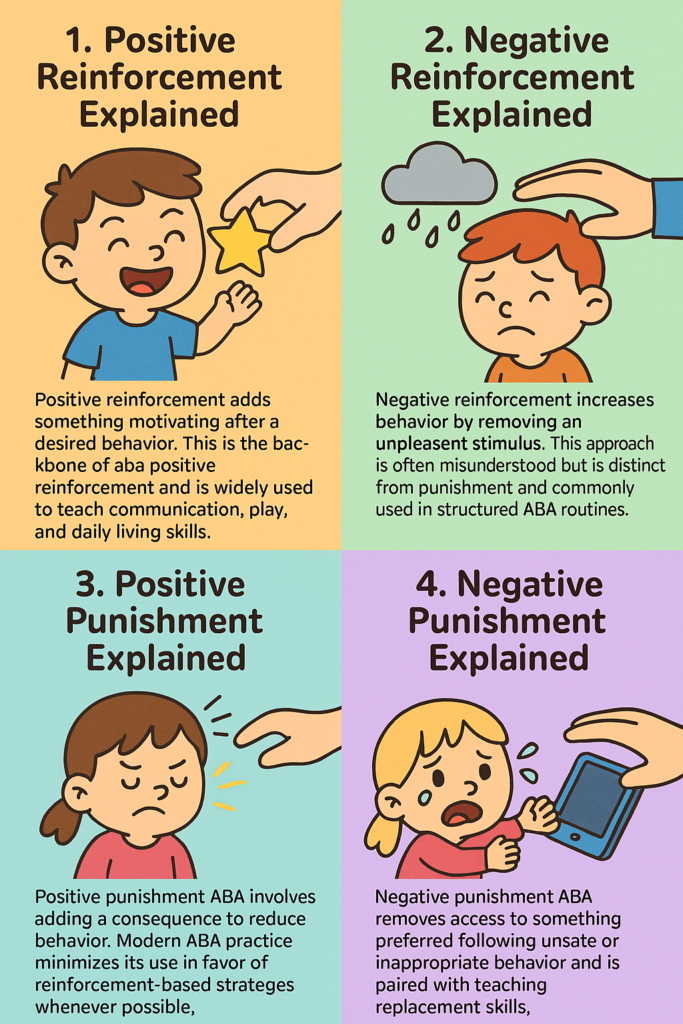
The 4 quadrants of operant conditioning explain how a child’s behaviors can increase or decrease depending on whether something is removed or added. Understanding the 4 quadrants of operant conditioning helps parents make sense of why specific strategies are chosen in therapy.
How Heartlinks Uses Operant Conditioning ABA to Support Children with Autism
Within individualized, ethical care models that emphasize skill-building and family collaboration, Heartlinks applies operant conditioning.
Creating Individualized Reinforcement Plans
Heartlinks tailors reinforcement plans to each of their young clients’ needs, including those with high-functioning autism traits or distinct learning profiles, which include signs of HFA.
Teaching New Skills Through Clear, Predictable Consequences
Using techniques such as tacting, ABA definition, modeling, and reinforcement, skills like communication and play can be taught and perfected.
Reducing Harmful or Unsafe Behaviors Safely
If a child demonstrates behaviors such as autism hand flapping, or autism spinning, therapists often shift their focus to applying behavior reduction ABA strategies based on positive support.
Partnering with Parents to Apply Techniques at Home
A key part of the success of operant conditioning is incorporating the help of families. At Heartlinks, families are coached in specific ABA techniques and learn how to apply them during daily routines, transitions, or community outings, including ABA in-home therapy when appropriate.
Parent Testimonial
Families often discover that consistent collaboration and long-term support make the most significant difference in their child’s progress. Many parents who partner with Heartlinks ABA describe meaningful growth not just in their child’s skills but also in confidence and day-to-day family life.
Kiondra Albert, Heartlinks parent shares:
“I have had an amazing experience with Heartlinks. My daughter has been a client with Heartlinks for almost three years, and I love the company and the service. I would definitely recommend them to anyone needing ABA services.”
Schedule your ABA therapy consultation today and get support.
Real Operant Conditioning Examples in ABA Therapy

In order to connect theory to everyday life, parents need to see operant conditioning examples of ABA in action.
Encouraging Communication Using Reinforcement
Reinforcing speech, gestures, or AAC that supports autism communication and is particularly beneficial for children with nonverbal autism or speech delays who are undergoing ABA therapy for speech delay.
Supporting Transitions and Daily Routines
To help autistic children manage transitions calmly and predictably, tools such as visual prompt, ABA, and task analysis can help.
Addressing Sensory-Driven Behaviors
Reinforcement can support safe alternatives and regulation for children who exhibit sensory-seeking behaviors, particularly in the context of autism, loud noise, or busy environments.
Promoting Independence through Positive Behavior Patterns
In real-life settings, a child’s independence is fostered through techniques such as NET in ABA or by incorporating examples of modeled behavior.
How Parents Can Use Operant Conditioning at Home
Often, parents play a key role in generalizing skills above and beyond their child’s regular therapy sessions.
Building Simple Reinforcement Routines
Creating consistent routines using applied behavior analysis strategies can help children succeed at home, in school, and throughout the community.
Choosing Effective Reinforcers
Reinforcers should match a child’s interests and regulatory needs, including calming techniques for autism when overstimulation occurs.
Avoiding Common Mistakes
Misinterpreting behaviors such as autistic defiance can lead to unintentional reinforcement. That’s where professional guidance can help parents respond effectively to challenging situations.
When to Seek ABA Support
If your child’s behaviors persist or escalate, at Heartlinks, we encourage families to explore a variety of options, such as community-based ABA therapy.
Operant Conditioning ABA Support with Heartlinks
Understanding operant conditioning ABA can empower families to see their child’s behavior through a more compassionate lens, one in which their actions are intentionally shaped through reinforcement, consistency, and ethical support. When implemented correctly, operant conditioning can help children with autism develop communication skills and independence, and strengthen their emotional regulation in ways that are predictable and safe for everyone involved.
At Heartlinks ABA, our experienced clinicians use evidence-based operant conditioning strategies as part of a highly individualized treatment plan tailored to your child’s strengths and challenges.
If you’re ready to learn more about operant conditioning ABA therapy in Atlanta, GA, or through any of our state providers, call Heartlinks ABA GA today at 410-517-3673 to start home, community, or school support. Our other state providers include:
Schedule your ABA therapy consultation today and get support.
Operant Conditioning ABA FAQs
- What is operant conditioning ABA?
Operant conditioning ABA is a learning approach that uses consequences to shape behavior, reducing challenging behaviors and increasing desirable ones.
- What are the four quadrants of operant conditioning?
The four quadrants are positive reinforcement, negative reinforcement, positive punishment, and negative punishment. Together, these quadrants describe how behaviors change when something is added or removed.
- How does operant conditioning help children with autism?
By providing clear, predictable feedback that eliminates confusion and frustration, operant conditioning helps children learn communication, daily living routines, and social skills.
- What is an example of operant conditioning in ABA?
A behavior is more likely to occur again if it’s learned through reinforcement. So, for instance, if a child earns praise or is rewarded with a favorite toy after asking for help, as opposed to yelling, they’re more likely to repeat the behavior.
- How is reinforcement different from punishment?
Punishment decreases a behavior by adding or removing something to reduce it. By comparison, reinforcement increases a behavior by adding or removing something that is motivating to achieve the same result.
- How can parents use operant conditioning at home?
By installing consequences during everyday routines, parents can reinforce positive behaviors immediately, establish clear expectations, and follow through consistently.