


What are Motivating Operations in ABA
In ABA therapy for autism, motivating operations are conditions or environmental events that change the value of a consequence and influence the probability of a particular behavior occurring. These changes occur before a behavior, and they affect whether the child is motivated to act. In ABA therapy for autism, understanding these conditions helps explain why motivation can shift so quickly.
Motivating operations, a core ABA concept, are instrumental in effective therapy because they help explain why a reinforcer works well at one point and not so well at another. When your autistic child is tired or overstimulated, they may not respond to the same motivators as usual.
Often, parents inadvertently encourage motivating operations, such as hunger, which can quickly increase their child’s motivation for snacks. Another example might be when too much time reduces their interest in their preferred toys.
Why Motivating Operations Matter for Children with Autism
In the case of children on the autism spectrum, their motivation can vary tremendously based on sensory needs, including sensory seeking behaviors, emotional regulation, and routines. To address challenging behaviors in autism, motivating operations ABA strategies are used to identify what is influencing them.
When motivating operations are misunderstood or overlooked, children may appear uncooperative or unmotivated, when in reality it’s their environment that’s working against them. By changing the conditions that affect their motivation, ABA therapy can be instrumental in reducing frustration and fostering meaningful learning.
Motivating operations ABA strategies are often used as part of behavior reduction ABA to proactively reduce frustration-driven behaviors.
Types of Motivating Operations in ABA Therapy
Establishing Operations (EO) in ABA
To increase the value of a reinforcer, establishing operations and ABA strategies are often used. For example, limiting your child’s access to their preferred toy or television show can increase their motivation to request it appropriately. An experienced BCBA therapist can implement EOs effectively to support your child’s learning without creating upset or anxiety.
Abolishing Operations (AOs) in ABA
To reduce the value of a reinforcer, ABA strategies are used. For example, if your child has unlimited access to a preferred item, their motivation for it may decrease. That’s why understanding AOs helps BCBA therapists avoid overusing reinforcers and adjust expectations when motivation drops.
Unconditioned vs. Conditioned Motivating Operations (UMOs vs. CMOs)
Hunger or fatigue are examples of unconditioned motivating operations (UMOs), which are biologically driven. By comparison, conditioned motivating operations (CMOs) develop through experience and learning, such as associating specific tasks with stress or success. Together, both play an essential role in how a child’s motivation can shift throughout the day.
Practicing MO Strategies Used in ABA Therapy for Autism
ABA therapists apply motivating operations alongside positive reinforcement aba strategies to support skill-building and reduce frustration.
Using Preference Assessments to Identify Effective Reinforcers
To learn what a child finds motivating at a given time, therapists often use preference assessments in ABA. It’s these assessments that help ensure reinforcers remain effective and meaningful, rather than simply taken for granted.
Increasing Motivation Through Deprivation and Access (Ethically Applied)
Within ABA therapy, deprivation refers to restricting a child’s access to a preferred item or activity for a period of time, thereby increasing the value and the likelihood they’ll engage in desired behaviors to get it. Access occurs when the desired item is provided immediately after a target behavior occurs, strengthening that behavior. In conjunction, a trained ABA therapist might create a deprivation by hiding a toy to make it more valuable to the child, and then provide controlled access to it only when the child learns to perform a targeted behavior, such as asking for the toy rather than screaming for it.
Reducing Problem Behavior Through Satiation and Choice
There are times when increasing a child’s access to preferred items can reduce a specific problem behavior. By offering choices and managing satiation, which occurs when a reinforcer loses its effectiveness because the child has been overexposed to it, children tend to feel more in control, thereby decreasing frustration-driven behaviors.
Teaching Requests Through Functional Communication Training
In functional communication training, children learn to request items, help, or breaks. Motivation is crucial to success, particularly for children with nonverbal autism, who may rely on alternative communication methods, such as gestures or picture exchanges. Without motivation, teaching a child functional communication training ABA strategies would not make communication more effective than their original problem behavior.
Rotation Reinforcers to Prevent Burnout and Satiation
Rotating reinforcers and allowing variation are critical to preventing an autistic child from losing motivation or experiencing burnout (for either the learner or the therapist). By varying rewards, you can help your child maintain high motivation and ensure positive reinforcement remains effective over time.
Real-World Examples of Motivating Operations in ABA Sessions
Increasing Communication During Learning Tasks

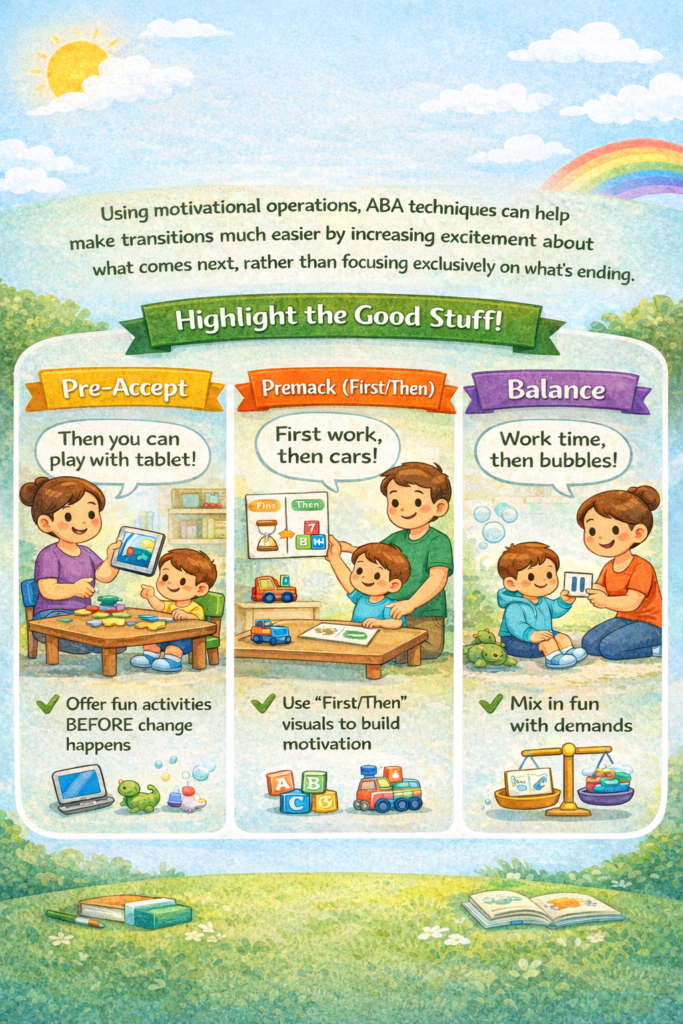
Supporting Transitions and Non-Preferred Activities
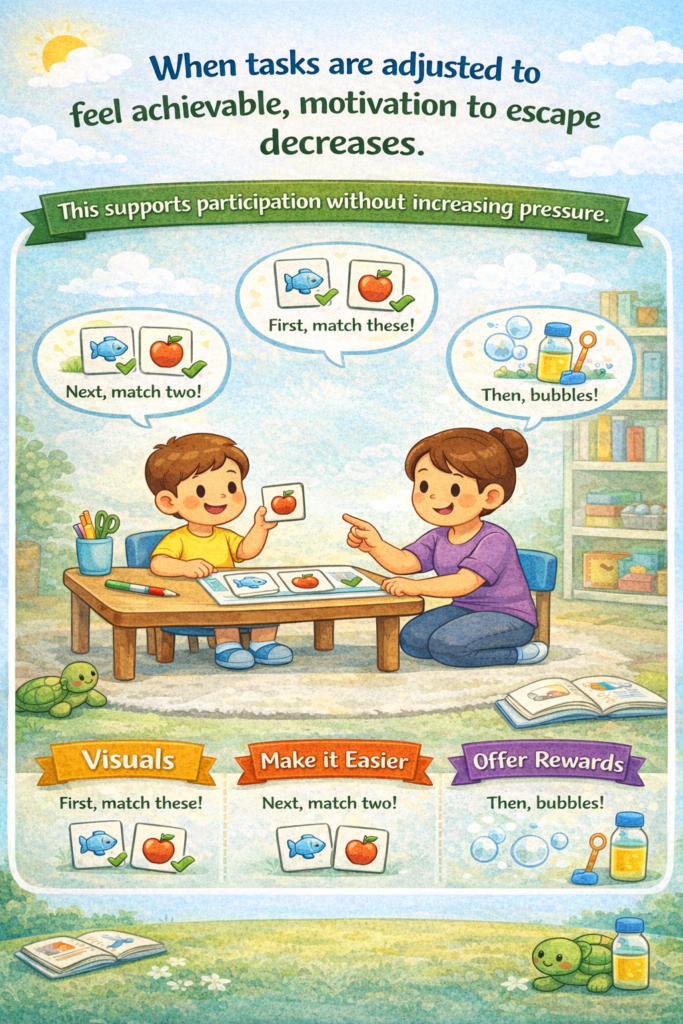
Reducing Escape-Maintained Behavior
Using MOs to Support Daily Living Skills

How Parents and Caregivers Can Support Motivating Operations at Home
Parents play a key role in supporting and motivating operations outside of therapy. With guidance from professionals, many strategies can be applied naturally through in-home ABA therapy.
Recognizing What Motivates Your Child
Motivation ebbs and flows for any human being, including children on the spectrum. By observing patterns of behavior, parents and caregivers can help adults align their expectations with their child’s current needs.
Avoiding Common Mistakes with Rewards
One of the most common errors parents make when supporting motivating operations at home is repeatedly relying on the same reward. If your child has regular or unrestricted access to a preferred item, its motivating value can decrease quickly and tremendously. In turn, this can make it less effective as a learning tool. That’s why rotating reinforcers, providing choices, and paying attention to your child’s interests can help maintain their motivation and keep their engagement level high. To prevent your child’s rewards from becoming a source of frustration for either of you, it’s essential to work directly with their therapist to ensure they’re being used ethically and intentionally.
Supporting ABA Strategies Across Home Routines
To generalize skills and understand expectations, it’s important to establish consistency across daily routines. Using ABA strategies such as clear prompting, visual supports, positive reinforcement, and planned response strategies helps children connect expectations across settings. In-home environments, including bedtime, homework, mealtimes, and transitions, provide natural opportunities to support motivating operations without creating artificial learning situations. Children are more likely to remain engaged when parents use consistent language, expectations, and reinforcement across all home routines.
When to Involve an ABA Therapist
If you’re experiencing consistent challenges with motivation that interfere with your child’s learning, daily routines, or communication, involving an ABA therapist can provide much-needed support and perspective. A BCBA therapist can evaluate which environmental factors, routines, or reinforcers may be affecting your child’s motivation and, in turn, make thoughtful adjustments to the motivating operations in ABA.
How ABA Therapy Uses Motivating Operations to Support Children with Autism

If you’re wondering how ABA strategies can support your child, professional guidance from Heartlinks ABA may help. Our trained ABA BCBA therapists can assess your child’s motivation in real time and adjust their strategies to support your child’s learning, communication, and emotional regulation without increasing frustration.
Our team provides individualized ABA therapy services that can be customized to each child’s needs and family routines, with support available in several different locations, including:
Many of our Heartlinks families also ask whether ABA therapy is covered by insurance, and our team can help you understand coverage options and next steps.
Ready to get started? Take a moment to reach out to our team to learn more about personalized ABA therapy options designed to support your child’s unique progress at home and throughout their life.
Motivating Operations ABA FAQs for Parents
- What does MO mean in ABA therapy?
MO stands for motivating operation, and explains the factors that affect a person’s motivation and behavior.
- What are motivating operations in ABA therapy?
Motivating operations are events or conditions that change how valuable a reinforcer is and how likely a behavior is to occur.
- What is an example of a motivating operation in ABA?
Limiting access to a preferred toy so a child is motivated to request it appropriately is a typical example.
- What is the difference between an establishing operation and an abolishing operation?
Establishing operations increases motivation for a reinforcer, while abolishing operations decreases it.
- How do motivating operations affect behavior in children with autism?
They influence engagement, communication, and emotional regulation by shaping motivation.
- How are motivating operations different from reinforcement in ABA?
Motivating operations change the value of a reinforcer, while reinforcement strengthens behavior after it occurs.
- Can parents use motivating operations at home with their child?
Yes, with guidance from an ABA therapist, parents can safely support motivation across routines.
- How can Heartlinks ABA help with motivating operations (MO)?
Hertlinks ABA can help by determining what truly motivates each child and then adjusting the learning environment to support engagement, skill development, and communication.