


Frustration, unmet needs including hunger or exhaustion, even sensory overload, these are just some of the reasons children on the autism spectrum display challenging behaviors. That’s where functional communication training ABA (FCT) comes in, as a highly effective method for teaching autistic children clearer, more effective ways to communicate their needs. The taught skills can be used at home, in school, and in their daily routines. Unlike focusing solely on reducing the behavior, FCT takes it one step further by teaching the child to replace it with meaningful, effective communication.
FCT is widely used throughout ABA therapy programs, including those at Heartlinks. The following guide explains FCT, why it works, and how parents can use it regularly with their children to encourage skill development across a range of environments.
What Functional Communication Training Means in ABA Therapy
At its core, functional communication training ABA focuses on teaching a child a new communication skill that serves the same purpose as the challenging behavior. If a child screams to escape a task, FCT may teach them to request a break instead. If they hit to gain attention, they may learn to tap an adult or use words to ask for interaction.
By addressing why a behavior occurs, FCT helps children meet their needs in more appropriate, effective, and socially supported ways.
How FCT Replaces Problem Behaviors with Communication
The basis of functional communication training ABA, is to teach a child new, more appropriate behavior that serves the same function as the challenging behavior. For instance, if a child screams when asked to complete a task, FCT can help by teaching them to ask for a break or a timeout.
The result is that FCT is a natural fit for families seeking a practical tool and replacement behaviors ABA that are straightforward for their child to use.
Why FCT Is Especially Effective for Children with Autism
Many autistic children have difficulty with communication, sensory needs, or being flexible in their daily routines. FCT is effective because it accomplishes the following:
- Teaches a skill as opposed to just stopping a behavior
- It is individualized for each child
- Can be used with words, pictures, gestures, or speech devices
- Reduces a child’s frustration level by giving them a choice.
FCT often works well in tandem with many families’ goals for autism communication strategies.
Understanding Behavior Functions in Parent-Friendly Terms
Every challenging behavior serves a purpose or function. The following are examples of the most common.
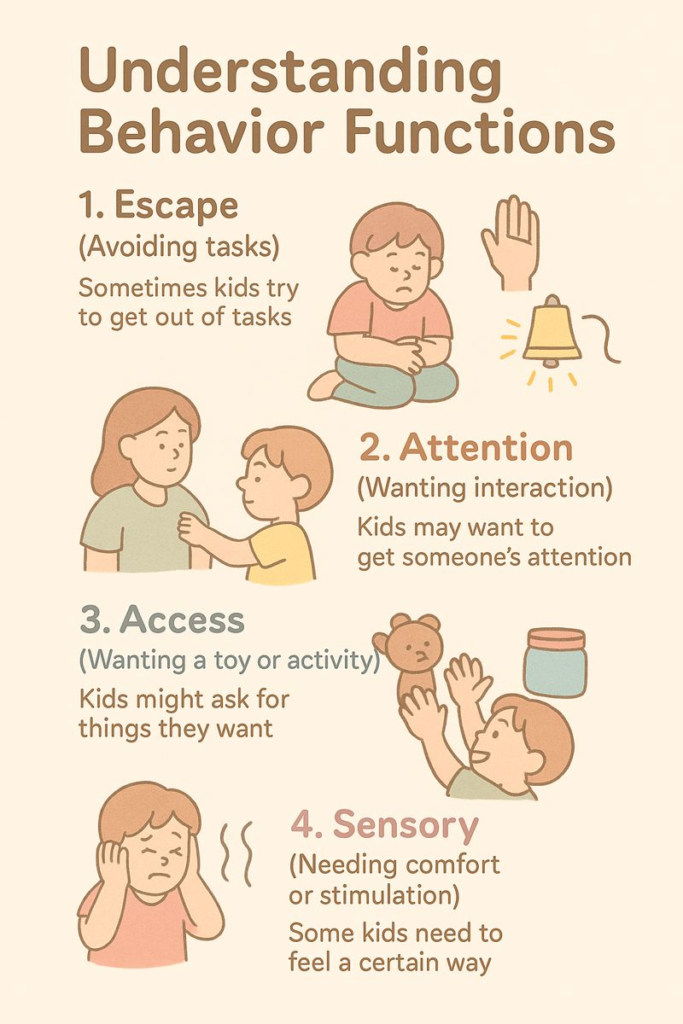
The first step in choosing a replacement skill that works begins with understanding the reason for the behavior.
How Heartlinks Teaches Communication-Based Replacement Behaviors
Identifying the Function Behind Challenging Behaviors
Typically, Heartlinks BCBAs begin by observing the child. It is during this process that they collect ABC data and identify the function or motivation behind the challenging behavior. By doing so, the intervention can target the root cause rather than just the surface behavior. Understanding the function of the behavior is also crucial for families who have incorporated ABA strategies at home.
Choosing the Right Replacement Skill for the Child
A successful replacement behavior must be:
- Easier to learn or use than the problem behavior
- Matched to the function
- Something the child can do (physically or verbally)
For example, if a child throws a toy to get an adult’s attention, the learned replacement might be to tap the parent’s arm and say ‘Look!”
Teaching Communication Skills Across Routines and Settings
There are several ways Heartlinks can teach FCT. During:
- Play
- Mealtimes
- Transitions
- Outings in the community
- School Routines
This ensures the child can use the skills anywhere, not only during therapy.
Partnering with Parents for Consistent Reinforcement
Parent involvement is critical throughout this process. Families can learn to apply ABA positive reinforcement to strengthen new communication skills, even during the most stressful moments.
If your child is demonstrating problem behaviors, our team at Heartlinks can help you understand the function of those behaviors and then choose the right communication skill.
FCT in ABA testimonial
Parent involvement is crucial throughout this process. Families can learn to apply ABA positive reinforcement to strengthen new communication skills, even during the most stressful moments.
Many families see meaningful progress when communication-based strategies are applied consistently and with professional support. One Heartlinks parent, Tangela Carthan, shared their experience:
“Heartlinks has been an absolute pleasure to work with. Jace and Fallon are truly the best duo anyone could ask for! My daughter has improved immensely under their care, and I couldn’t be more grateful for their support and dedication.”
Common Replacement Behaviors Taught Through FCT
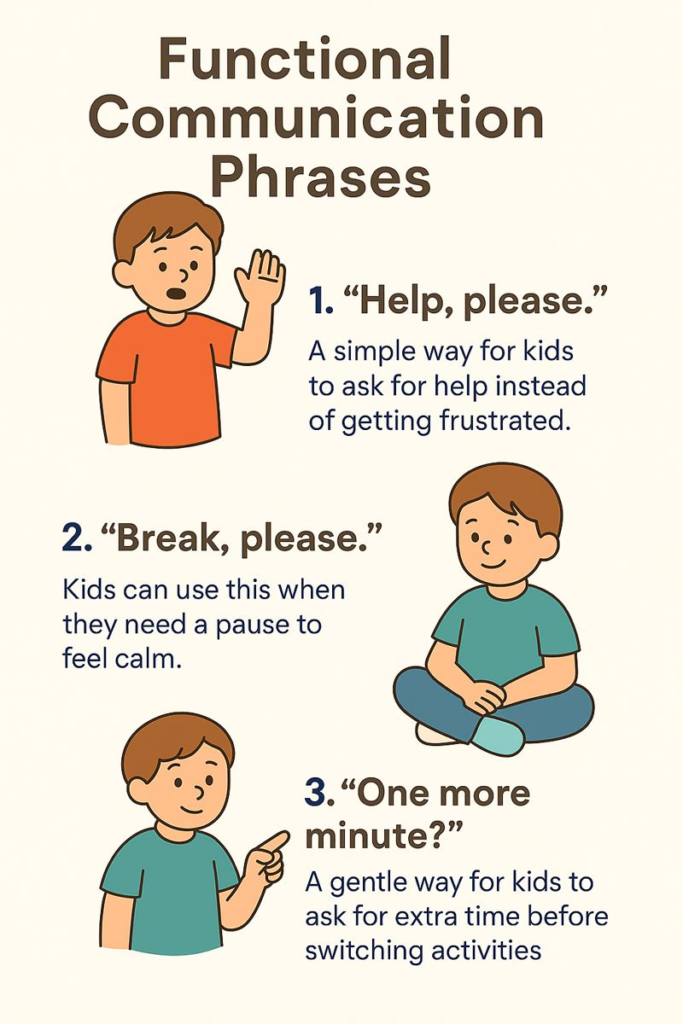
Requesting Help or Breaks Instead of Escaping Tasks
Children learn functional phrases such as:
Using Words, Pictures, or Devices to Ask for What They Need
Many children benefit from FCT through verbal requests, AAC devices, or picture cards (PECS).
Replacing Attention-Seeking Behaviors with Clear Communication
As opposed to yelling, hitting, or interrupting, the replacement behavior might be:
- Saying, “play with me?”
- Handing a picture to request attention
Communicating Sensory Needs Safely
Children may learn to request the following equipment or surroundings:
- Headphones
- A sensory break
- A quiet space
- Deep pressure
These relate closely to patterns observed in sensory seeking behavior.
Real FCT Examples for Autistic Children
FCT ABA is most effective when families understand how it applies to everyday situations. The following real-world examples demonstrate how challenging behaviors can be replaced with simple and effective communication skills that meet the same need.
FCT for Transitions and Daily Routines
Understandably, transitions are a common trigger for frustration. This is particularly true when a child is asked to stop a preferred activity and move to something unfamiliar. Rather than refusing or melting down, FCT ABA teaches the child how to communicate their needs. For example, they might learn to say “one more minute?” or learn to use a timer card. In both situations, the child can ask for more time in a calm, appropriate manner.
FCT for Communication-Related Frustration
When autistic children have difficulty expressing themselves, their level of frustration can rise dramatically. It may manifest as hitting, screaming, or throwing objects. FCT ABA replaces these less desirable behaviors by teaching your child to say “help please!” When your child can use this phrase, you and their other caregivers can respond immediately, thereby automatically reinforcing communication rather than problem behavior.
FCT for Access-Seeking Behaviors
If a child wants a toy, a snack, or to participate in a specific activity, you might see challenging behavior. Instead of grabbing or screaming, FCT in ABA teaches your child to request the item using words, a device, or even their own words. Over time, this supports behavior reduction ABA by decreasing challenging behaviors.
FCT for Sensory-Driven Behaviors
From covering their ears to running out of the room, sensory overload can lead to some dramatic behaviors. However, FCT ABA shows children on the spectrum that there are options, such as sensory support. So whether it’s wearing headphones, asking for a break, or calmly moving to a quiet space, all of these options allow the child to meet their sensory needs safely while reducing distress.
And many families practice these skills successfully through ABA in-home therapy, where communication strategies are applied directly to daily routines.
How Parents Can Support Functional Communication Training at Home

Reinforcing Replacement Behaviors Consistently
The success of FCT depends largely on parent participation. By reinforcing their children’s newly acquired skills daily, this ensures they become habits and supports long-term behavior reduction through ABA.
Using Simple Prompts and Visual Supports
Whether it’s using visuals, gestures, or short verbal prompts, parents can help their children remember the learned replacement behavior without overwhelming them.
Encouraging Practice Across Environments
Home, school, stores, playgrounds, and community spaces all offer opportunities to practice communication.
When to Seek ABA Support for Behavior Challenges
Are challenging behaviors increasing or becoming problematic? In the event of an unsafe situation, Heartlinks can help families identify the function and build a personalized plan.
Seeking FCT in ABA Support from Heartlinks
Functional Communication Training assists children on the spectrum by replacing challenging behaviors with clear, effective communication that supports their independence and confidence. If you and your family would like help developing an FCT ABA plan for your child, contact our ABA specialists to get started.
Heartlinks ABA proudly serves families across multiple states, including
Functional Communication Training ABA FAQs
- What is functional communication training ABA?
This is an ABA therapy that teaches children a new and more socially acceptable means of communication that meets the same need as the former problematic behavior.
- How does FCT help autistic children?
FCT can help reduce an autistic child’s frustration, improve their communication, and make challenging situations more manageable.
- What are examples of replacement behaviors in ABA?
There are many examples of replacement behaviors in ABA, including requesting help, asking for breaks, or someone’s attention, or directly communicating sensory needs.
- How do you identify the function of a behavior?
Typically, a trained BCBA therapist will observe a child’s ABC patterns to understand the motivation behind the behavior. It’s that observing that will determine if the behavior is escape-based, sensory-driven, attention-seeking, or access-motivated.
- How long does FCT take to show progress?
Often, within days or weeks, children on the spectrum can be seen using their learned FCT skills, provided reinforcement is consistent.
- Can parents use FCT strategies at home?
Absolutely! FCT is most effective when parents can reinforce the learned communication skill throughout the day.