


The ICD-10-CM diagnosis code for Autism Spectrum Disorder (ASD) in 2026 is F84.0, or officially labeled as “autistic disorder.” This billable code is required for a variety of medical documentation, insurance claims, and service authorizations, such as ABA therapy. Even though DSM-5 uses the broader term “autism spectrum disorder,” ICD-10-CM continues to use F84.0 for coding across a number of healthcare and insurance systems.
| Diagnosis | ICD-10-CM Code | Billable | Primary Use |
| Autism Spectrum Disorder | F84.0 | Yes | Medical diagnosis and insurance billing |
| Intellectual Disability (if applicable) | F70–F79 | Yes | Co-occurring diagnosis |
| ADHD (if applicable) | F90.0–F90.9 | Yes | Co-occurring diagnosis |
Whether your child has just received an autism diagnosis or you’re staring at a piece of paperwork with “F84.0” printed on it and don’t know what it means, you’re not alone. This code appears regularly in evaluation reports, insurance forms, and school documentation. Yet, almost nobody explains what it is or why it looks the way it does. Read on to learn what F84.0 means, who assigns it, what documentation accompanies it, and how it relates to getting ABA therapy covered.
What is the ICD-10 Code for Autism Spectrum Disorder?
The Official ICD-10-CM Code for Autism Spectrum Disorder in 2026
The current ICD-10-CM code for autism spectrum disorder is F84.0. As of October 1, 2025, this code became effective and remains the standard for the 2026 fiscal year. Healthcare providers, insurance companies, and billing departments use F84.0 to document autism diagnoses and process claims for related services. This follows the coding guidance that’s maintained by the Centers for Medicare and Medicaid Services 1.
What F84.0 Means
Officially, F84.0 is labeled “autistic disorder”. Though it may sound a bit dated, it dates back to an earlier diagnostic era. The term was developed before the DSM-5 included several separate diagnoses, including Asperger’s Syndrome and pervasive developmental disorder, into the single umbrella term of “Autism Spectrum Disorder.”
Is F84.0 a Billable Diagnosis Code?
Yes. F84.0 is a billable, specific ICD-10-CM code, which means it can be used on ABA therapy insurance coverage claims and any reimbursement paperwork without needing an additional or more detailed code.
Understanding ICD-10 Coding for Autism
How ICD-10-CM is Used in Healthcare
ICD-10-CM is the coding system that translates a clinical diagnosis of autism into a format that insurers, hospitals, and government health programs can process and understand. From a broken arm to a mental health condition, every diagnosis has a specific alphanumeric code. This allows providers to explain, in a universal language, why a service was medically necessary, which in turn allows insurance to pay for it.
The Difference Between ICD-10-CM and DSM-5
The DSM-5 stands for the Diagnostic and Statistical Manual of Mental Disorders. The American Psychiatric Association publishes it on a regular basis, and it is the standard classification system in the US. The number five reflects the edition of the DSM; in this case, the fifth edition, the most recent, was published in 2022. The DSM-5 is the manual clinicians use to diagnose mental health and developmental conditions. It groups autism-related diagnoses under one category: Autism Spectrum Disorder, with different severity levels described in detail.
By comparison, the ICD-10-CM is a billing and classification system that’s maintained separately. It still uses older category names such as “Autistic Disorder” (F84.0) and “Pervasive Developmental Disorder, Unspecified” (F84.9).
So a clinician may diagnose your child with Autism Spectrum Disorder using DSM-5 criteria, and then bill for it using the ICD-10 code F84.0. The two systems describe the same clinical reality; they just use different labels to do so.
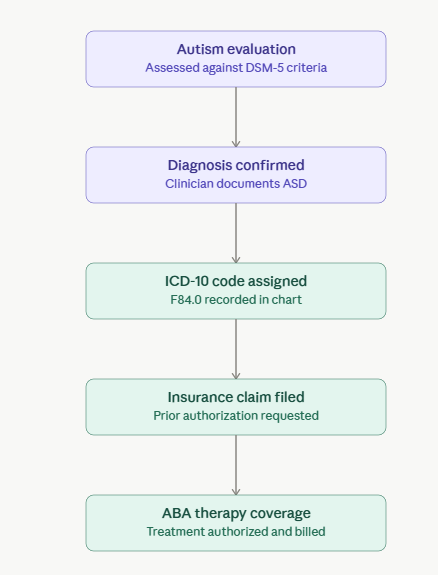
F84.0 is the link between a clinical diagnosis and ABA therapy insurance coverage — here’s how the two systems connect.
Why the Diagnosis is Still Coded as F84.0
ICD-10-CM hasn’t been restructured to match DSM-5’s single-spectrum approach, and there’s no announced date for that to change in the U.S.The WHO’s (World Health Organization’s) newer system, ICD-11, consolidates autism into a single code with severity qualifiers, but the U.S. hasn’t adopted it for clinical billing yet.
Have questions about an autism diagnosis or insurance coverage? Our team can help you understand the next steps and connect you with appropriate resources. Talk with our team today.
Who Can Diagnose Autism Spectrum Disorder?
Healthcare Professionals Qualified to Diagnose Autism
F84.0 can only be assigned after a formal evaluation by a qualified provider such as a developmental pediatrician, child psychologist, psychiatrist, neurologist, or a licensed clinical psychologist trained in autism assessment.
What Happens During an Autism Evaluation?
There are several key areas touched on during an evaluation. Those include your child’s developmental history going back to their infancy, direct observation using standardized tools (this is often what people mean by diagnostic testing for autism), interviews with parents or caregivers, and sometimes input from teachers who regularly work with the child. What the evaluator is looking for is patterns that match DSM-5 criteria: differences in social communication and restricted or repetitive behaviors and interests. The CDC’s publication of guidance for healthcare providers on the criteria and diagnostic tools used to identify ASD helps ensure consistency in evaluations across providers.
When an ICD-10 Diagnosis is Assigned
When the evaluation is complete, and the clinician confirms that your child meets the diagnostic criteria for autism, F84.0 is added to their medical record. That’s when the diagnosis becomes official for billing and treatment planning, and it’s often at this point that families start looking into early autism intervention options.
Documentation Requirements for An Autism Diagnosis
An autism evaluation needs to show the reasoning behind the diagnosis, not just the diagnosis itself. That’s why insurers look for a few specific pieces.
Clinical History and Developmental Information
Insurers are looking for a documented developmental history, including when milestones were reached or missed, what caregivers noticed early in your child’s life, and any relevant medical history. This information reflects an actual developmental pattern rather than a one-off observation.
Behavioral Observations and DSM-5 Criteria
The report needs to link specific behaviors to the DSM-5 diagnostic criteria. Not only the social communication element but also the restrictive or repetitive behaviors element. This section carries the majority of the clinical weight in an evaluation.
Standardized Autism Assessment Tools
Evaluators use one or more validated assessment instruments to conduct an evaluation. These tools give insurers a consistent way to judge the severity and presentation of your child’s symptoms across different providers.
Supporting Medical Necessity for Treatment
The diagnosis alone won’t establish medical necessity. Instead, insurers want documentation connecting F84.0 to a specific form of recommended treatment, ABA therapy, speech therapy, or occupational therapy, and explaining why this approach fits the individual. If you and your family continue to weigh your options, it’s worth reading up on the best therapies for autism to see what’s traditionally recommended at your child’s age.
Accurate documentation supports insurance approval and ensures that children receive appropriate autism services. Speak with a Heartlinks ABA support specialist today.
How ICD-10 Code F84.0 is Used for Insurance
Using F84.0 for Insurance Claims
Medical providers attach F84.0 to claims for autism-related evaluations, therapies, and a range of follow-up care. From there, insurers use it to confirm a billed service is connected to an autism diagnosis, and coverage rules often depend on which code is on the claim.
Prior Authorization for ABA Therapy
Is ABA therapy covered by insurance?
Before ABA therapy can begin, most plans require pre-authorization. F84.0 is part of that request process, along with a treatment plan, recommended hours, and a case for medical necessity. When authorization is granted, many families also take a closer look at ABA therapy at home to keep their child’s progress going between sessions.
Medicaid and Private Insurance Requirements
According to federal law, Medicaid must cover medically necessary autism treatment, including ABA therapy, regardless of state of residence, though the authorization process varies by region. By comparison, private insurance varies more. Some plans require extensive documentation and periodic reauthorization, while others require less. Coverage differs enough between plans that it’s advisable to call your insurer to confirm your specific plan and what they require.
When Updated Documentation May Be Required
Don’t be fooled: an initial authorization isn’t permanent. Insurers often request updated evaluations or progress reports to maintain authorization of services. That’s a standard part of the utilization review process and not a challenge to the original diagnosis.
Common ICD-10 Coding Mistakes to Avoid
Using Outdated Diagnostic Terminology
Mixing old and new terminology can create problems on a claim or in school paperwork. For instance, older records sometimes list “Asperger’s syndrome” as a standalone category-but under the current system it’s coded separately as F84.5.
Incomplete Clinical Documentation
A code on its own doesn’t tell an insurer too much. If your child’s supporting evaluation, such as their developmental history or specific behavioral details tied to diagnostic criteria, is missing, claims can be delayed or even denied.
Assuming the Diagnosis Code Alone Guarantees Coverage
An F84.0 on your child’s medical chart doesn’t mean that every autism-related service they require will automatically be covered. Coverage still depends on your specific level of coverage, the documentation that establishes medical necessity, and whether prior authorization has been secured. This is one of the most common mistakes that parents make after the initial diagnosis.
Frequently Asked Questions About Autism ICD-10 Codes
What is the ICD-10 Code for autism spectrum disorder?
Officially, F84.0 is “autistic disorder.” It’s a billable ICD-10-CM code used to diagnose, document, and submit insurance claims related to autism.
Is F84.0 still the correct diagnosis code in 2026?
Yes! It’s part of the current ICD-10-CM update, which became effective on October 1, 2025.
Why does ICD-10 use the term “autistic disorder” instead of autism spectrum disorder?
ICD-10-CM’s terminology predates DSM-5’s move to a single spectrum diagnosis. As a result, their coding system hasn’t been updated to match it.
Can adults receive an autism diagnosis using F84.0?
Yes. The F84.0 diagnosis isn’t limited to children. Adults who’ve been evaluated and meet the criteria can also be diagnosed. However, the adult evaluation process may be different from that for children.
Does insurance require an ICD-10 diagnosis before ABA therapy?
Yes. The majority of insurers require a documented F84.0 diagnosis and supporting documentation before authorizing or reimbursing ABA therapy.
Who can assign an autism diagnosis code?
Only qualified healthcare providers in a variety of fields, from developmental pediatrics and psychiatry to neurology and psychology.
If your child has recently been diagnosed with autism, or you’re trying to understand your autism insurance coverage and what it means for ABA therapy, our team can help you figure out the next steps. Schedule a consultation.
Resources
- Centers for Medicare & Medicaid Services. (2026, June 5). ICD-10. https://www.cms.gov/medicare/coding-billing/icd-10-codes
- Centers for Disease Control and Prevention. (2026, May 21). Autism spectrum disorder (ASD). https://www.cdc.gov/autism/index.html