

Do autistic people lack empathy? No. The idea of someone with autism lacking empathy is a common myth that’s not supported by current research. Several prominent studies indicate that autistic individuals can experience tremendously deep emotional empathy but may express it differently or have difficulty interpreting certain social cues around the subject1.
Understanding the link between autism and empathy can help parents, educators, and caregivers move beyond stereotypes and better support meaningful relationships with their children on the spectrum.
In this article, we’ll explore what research says about autism and empathy; why the myth persists; how concepts like double empathy and alexithymia contribute to misunderstandings; and how ABA therapy can help autistic children build genuine social connections.
Do Autistic People Lack Empathy
The belief that autistic people are uncaring, self-centered, or unable to understand others has been a pervasive myth for decades. Luckily, modern research consistently challenges this assumption, indicating that autistic people can feel strong emotional concern for others, sometimes even more intensely than their neurotypical peers.
What the research actually shows
Research indicates that autistic individuals often experience and express empathy differently, as opposed to the false belief that they lack it altogether. Many studies have found that autistic children can and often do feel strong emotional concern for others, and even more intensely than others.
Researchers now recognize that empathy is not a single skill. Rather, it involves multiple processes: understanding emotions, recognizing social cues, and responding appropriately. Experiencing difficulties in one area does not necessarily mean an autistic child lacks empathy.
Every child experiences and expresses emotions differently. If you have questions about your child’s social development, talk to a Behavior Analyst at Heartlinks ABA today.
Why does the myth of autism and lack of empathy persist?
Usually, the myth of a correlation between autism and lack of empathy stems from differences in communication and social expression. Differences in autism communication styles can sometimes be mistaken for a lack of emotional awareness when that is not the case. For instance, an autistic child may not make direct eye contact, respond with the traditional facial expressions, or verbally acknowledge someone’s feelings.
To the untrained eye, these behaviors can appear uncaring. In reality, the child may deeply understand or feel concern for another person’s emotions but express it in an untraditional way.
Often autistic individuals report feeling overwhelmed by others’ emotions as opposed to being disconnected from them, which further challenges the stereotype.
Understanding the Different Types of Empathy in Autism
To understand the relationship between autism and empathy, it’s important to understand what the other person may be thinking or feeling.
First and foremost, like autism, empathy is a spectrum, and within the autistic community it is generally divided into separate but primary groups: cognitive and affective empathy.
Cognitive Empathy-Why Reading Social Cues Can Be More Difficult
Cognitive empathy is the capacity to understand another person’s thoughts and perspectives intellectually. Also known as perspective-taking or putting yourself in someone else’s shoes, cognitive empathy involves the ability to mentally grasp and understand another person’s point of view, intentions, and emotions.
Children on the spectrum may have difficulty interpreting facial expressions, body language, or sarcasm, or the implied meaning in various conversations. These challenges are often related to differences in social processing rather than an absence of empathy. They can affect social skills for high-functioning autism as well as broader relationship-building skills.
Yet it’s worth noting that difficulty interpreting social signals is not the same as a lack of concern for another person’s well-being.
Affective Empathy-Why Many Autistic People Feel Deeply
Whether it’s emotionally sharing or responding to another person’s feelings, this is known as affective empathy.
Many autistic individuals demonstrate strong affective empathy, becoming distressed when others are hurt or showing deep concern for people they care about.
What is hyper-empathy in autism?
In some cases, an autistic child’s empathy may be so intense that it becomes overwhelming, making it difficult to know how to respond in the moment. This is known as hyper-empathy in autism. Children on the spectrum who have hyper-empathy not only feel someone else’s emotions but often experience them even more intensely than the person they’re empathizing with.
Some of the signs or symptoms of hyper-empathy in autistic children can include the following:
- Feeling someone else’s joy or sadness for several days after being around them.
- Experiencing a strong physical or emotional reaction when observing people in a challenging situation.
- Finding it challenging to establish boundaries with others due to concern and sorrow for what they’re experiencing.
- Neglecting their own personal care due to the emotional overwhelm from someone else’s problems.
What is the Double Empathy Problem?
The double empathy problem suggests that communication challenges between autistic and non-autistic people are often mutual. Rather than reflecting a deficit in one person, misunderstandings can occur because each individual experiences and interprets the world differently.
How Communication Differences Create the Appearance of a Deficit
For many years, social challenges in autistic children were considered proof that children and adults on the spectrum lacked empathy. Yet the double empathy problem offers a different explanation. It suggests that communication breakdowns occur because both groups have equal communication differences. From literal language use to directness and divergent pacing, these differences create a false appearance of a deficit because one style is treated as the unspoken standard (that of the neurotypical person).
Why the burden of understanding should not fall solely on autistic individuals
Historically, autistic people have been expected to adapt to neurotypical social expectations, while non-autistic individuals were rarely encouraged to adjust their own communication styles. The double empathy problem highlights why this approach can be limiting.
When parents, educators, peers, and professionals make an effort to understand autism communication styles, their interactions often become more successful and hence more meaningful. Rather than viewing autism as a deficit to be fixed, this perspective encourages mutual understanding, flexibility, and respect.
What is Alexithymia and How Does it Affect Empathy in Autism?
Alexithymia is a personality trait that’s characterized by severe difficulty identifying, describing, and processing one’s own emotions. Up to 50% of autistic individuals are impacted by alexithymia2. It affects empathy by impairing a person’s ability to recognize and respond to others’ emotional states.
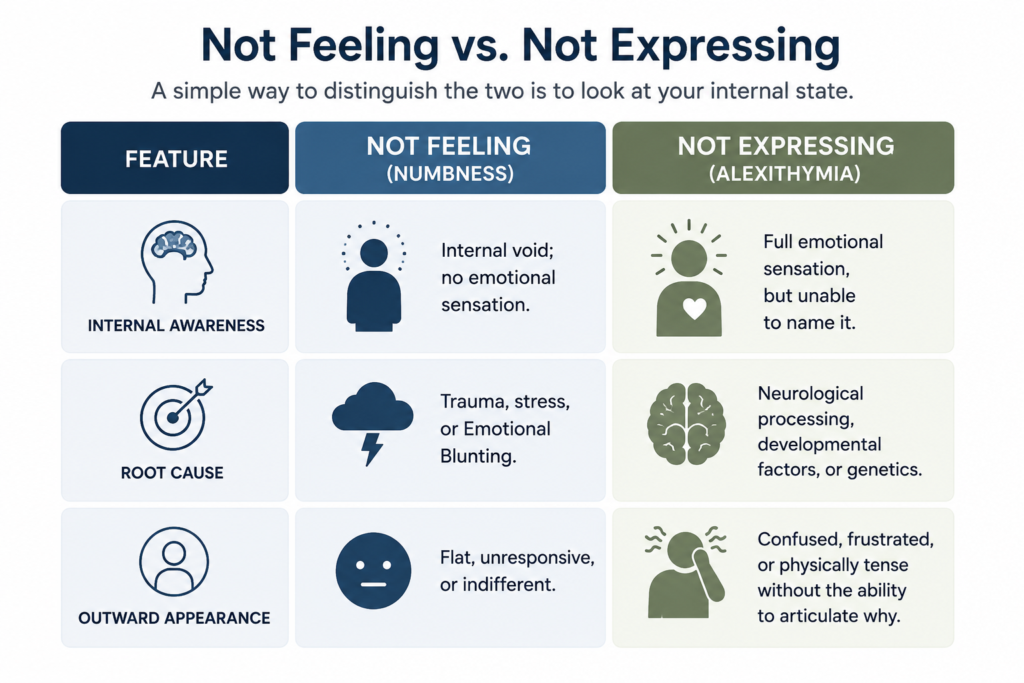
The Difference between not feeling and not being able to express feelings
Not feeling refers to a physiological or psychological absence of emotions, also known as emotional numbness. Not being able to express feelings means experiencing emotions fully but struggling to communicate or process them.
The distinction highlights the difference between the internal experience of our emotions and their external expression.
If you’re emotionally numb, you might feel physically present in a situation but entirely detached from joy, fear, sadness, or anger. Being emotionally numb is often an involuntary survival mechanism. It’s often closely linked to trauma, severe depression, or other issues.
By comparison, if you are emotionally blind or suffering from Alexithymia, you may experience the physical symptoms of an emotion, such as your heart racing or tightness in the chest. This can contribute to challenges with autistic emotional regulation and identifying feelings in real time. Still, you’re unable to recognize the emotion and how to put it into words.
How to tell the difference between Alexithymia and Emotional Numbness
How Alexithymia is distinct from autism itself
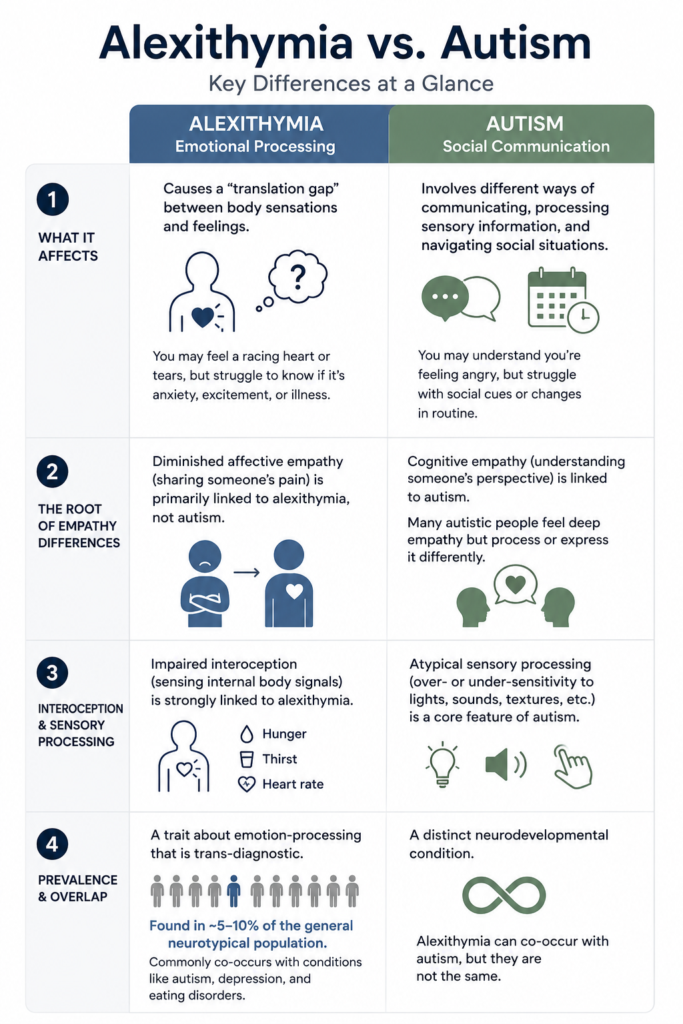
The core difference between the two conditions is that autism affects social communication and sensory processing, while alexithymia affects emotional and internal bodily awareness.
The distinctions between the two can be broken down into these core areas:
How ABA Therapy Helps Autistic Children Build Genuine Connection
Teaching Emotion Recognition and Perspective-Taking
Many autistic children deeply care about others but may process emotions and social information differently. ABA therapy can help children recognize facial expressions, body language, tone of voice, and contextual clues that signal how someone might be feeling. Rather than teaching children to simply ‘act normal,’ a BCBA therapist focuses on helping them understand their emotions in ways that make sense to them.
From natural interactions and visual supports to role-playing activities and real-life situations, these are just some of the many ways perspective-taking skills are often taught. Using these strategies helps children learn to identify different viewpoints, understand how their actions can affect others, and how to handle social situations with greater confidence. As they’re practiced and adopted, these skills can help children on the spectrum develop stronger friendships, improved family relationships, and foster more meaningful participation in school and throughout community settings.
One parent, Anita T, shared:
“Our BCBA and RBT truly care about my son and treat him like family. Heartlinks has been excellent with communication and making sure his needs are met. We’ve seen meaningful improvements in his communication and behavior, and we’re grateful to have them on this journey with us.”
Building Communication Tools That Support Authentic Expression
Authentic connection starts with the ability to communicate needs, thoughts, interests, and feelings. ABA therapy helps autistic children develop their autism communication skills that reflect their individual strengths and preferences. For some children, this may involve developing spoken language. Yet for others on the spectrum, it may include alternative or augmentative communication devices, sign language, the Picture Exchange Communication System, or other communication supports commonly used by individuals with nonverbal autism.
The goal is not to change what a child wants to say, but to help them express themselves more effectively. When children have a reliable way to communicate, they’re more likely to advocate for themselves, express their interests, participate in conversations, and build relationships based on mutual understanding. Many ABA programs accomplish this through functional communication training, which teaches children practical ways to express their needs and emotions. By recognizing each child’s communication style, ABA therapy can encourage more meaningful interactions for everybody involved.
One Heartlinks parent, Ricio C. shared:
“Heartlinks has been a tremendous help in my son’s progress. Thanks to his therapists and the support they provide at home, he has been able to make significant strides in following directions and even started asking for things on his own. We’re so grateful for the difference they’ve made.”
What ABA Does Not Do: It Does Not Force Neurotypical Social Scripts
The focus of modern ABA therapy is increasingly on autonomy, self-advocacy, and quality of life as opposed to encouraging children on the spectrum to mimic neurotypical behaviors. Ethical, neurodiversity-affirming ABA does not seek to eliminate harmless autistic traits, including stimming behaviors, unique interests, or alternative communication styles, simply because they appear different.
Rather than teaching rigid social scripts or requiring eye contact, therapists help children develop practical skills that allow them to connect with others in ways that feel comfortable and authentic. The emphasis is on expanding opportunities for autism communication and social engagement while respecting each child’s individuality. Genuine connection is earned when a child feels understood and accepted, not from masking one’s natural way of experiencing the world.
If your child is struggling to connect with others, ABA therapy can help them develop the tools they need-on their own terms. Contact Heartlinks today.
Helping Children Build Meaningful Connections Through ABA Therapy
At its foundation, ABA therapy is not about changing who an autistic child is. It’s about helping children develop the communication, self-advocacy, and autism emotional regulation skills they require to develop meaningful relationships on their own terms.
At Heartlinks ABA, we believe every child deserves the support that honors their unique strengths, interests, and communication styles. Our experienced team works closely with families to create customized ABA programs for autism focused on practical, real-world skills that help children thrive at home, in school, and in their communities.
Start with a consultation today.
Whether you’re looking for:
- ABA Charlotte NC
- ABA therapy New Jersey
- ABA therapy Atlanta GA
- ABA therapy Indiana
- ABA therapy in Baltimore, Maryland
Our team provides compassionate, evidence-based services that are designed to help children reach their full potential.
Talk to one of our professionals today
Frequently Asked Questions About Autism and Empathy
Is there a link between autism and lack of empathy?
No. Research shows that autistic people can experience deep empathy but may express it differently than others.
Is lack of empathy associated with autism?
No. Autism can affect social communication and emotional expression, but it does not mean a person lacks empathy or concern for others.
How do autistic people show love?
Autistic people often show love through actions, shared interests, quality time, practical support, or thoughtful gestures.
Do autistic people struggle with boundaries?
Some children on the spectrum may find social boundaries challenging due to differences in communication and social understanding. These skills can improve with practice and the right support.
What is the 6-second rule in autism?
The 6-second rule involves pausing after asking a question or giving a direction. This extra time allows autistic individuals to process information and respond.
What is the double empathy problem?
The double empathy problem implies that misunderstanding between autistic and neurotypical people is often mutual. Both groups communicate and interpret social situations differently.
Resources
- Verrier, D., Connolly, S., & Kimber, L. (2024, January 17). Autism and empathy. National Autistic Society. https://www.autism.org.uk/learn/knowledge-hub/professional-practice/autism-and-empathy
- Milton, D. E. M. (2022). The double empathy problem: A decolonizing metaphor in autism research. Frontiers in Psychology, 12, Article 779231. https://doi.org/10.3389/fpsyg.2021.779231