


There isn’t a parent on the planet who wouldn’t feel discouraged or overwhelmed when their child hits, screams, or runs away when they refuse to follow directions. These behaviors are often misunderstood as “bad behavior.” However, in reality, they are attempts to communicate a need. But there is an alternative to relying on aggression, tantrums, or escape behaviors: replacement behaviors. ABA strategies help children learn safer and more effective ways to express themselves.
In ABA therapy, replacement behaviors are intentionally taught to children so they can accomplish the same goal as their former challenging behaviors once served; the difference is that they are a more socially acceptable and functional way to act. When used consistently and effectively, ABA replacement behaviors can support your autistic child’s communication, autism emotional regulation, and long-term skill development.
What Are Replacement Behaviors in ABA?
Replacement behaviors in ABA are appropriate, teachable actions designed to serve as alternatives to challenging behavior while achieving the same purpose. Simply put, replacement behaviors show an autistic child what to do instead of resorting to less desirable behavior.
A replacement behavior might involve:
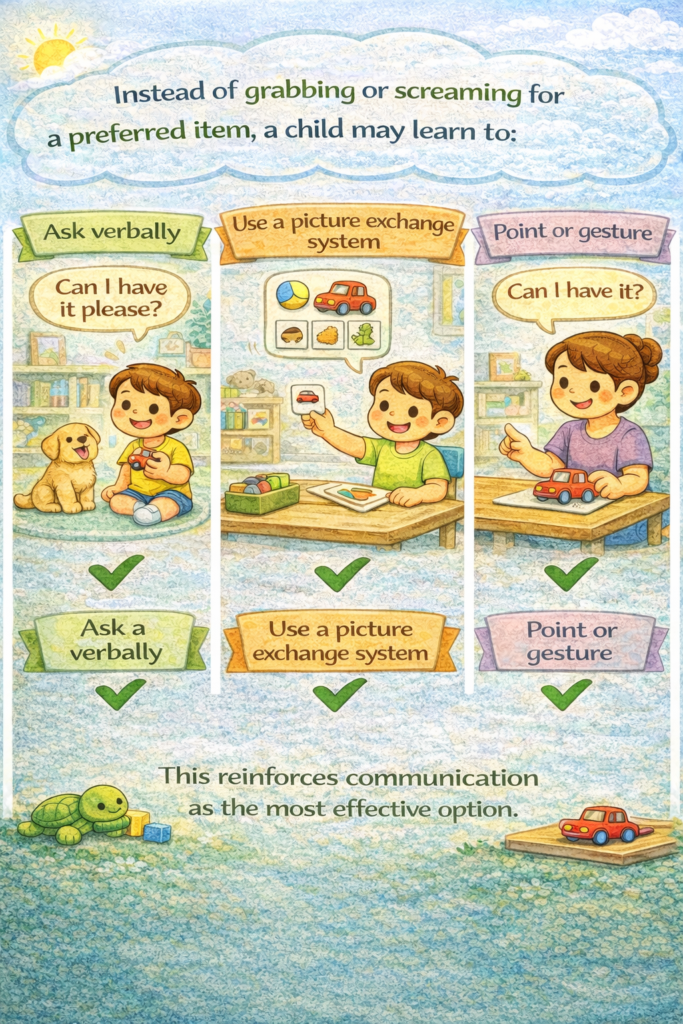
- Communicating a need using words, signs, or visuals
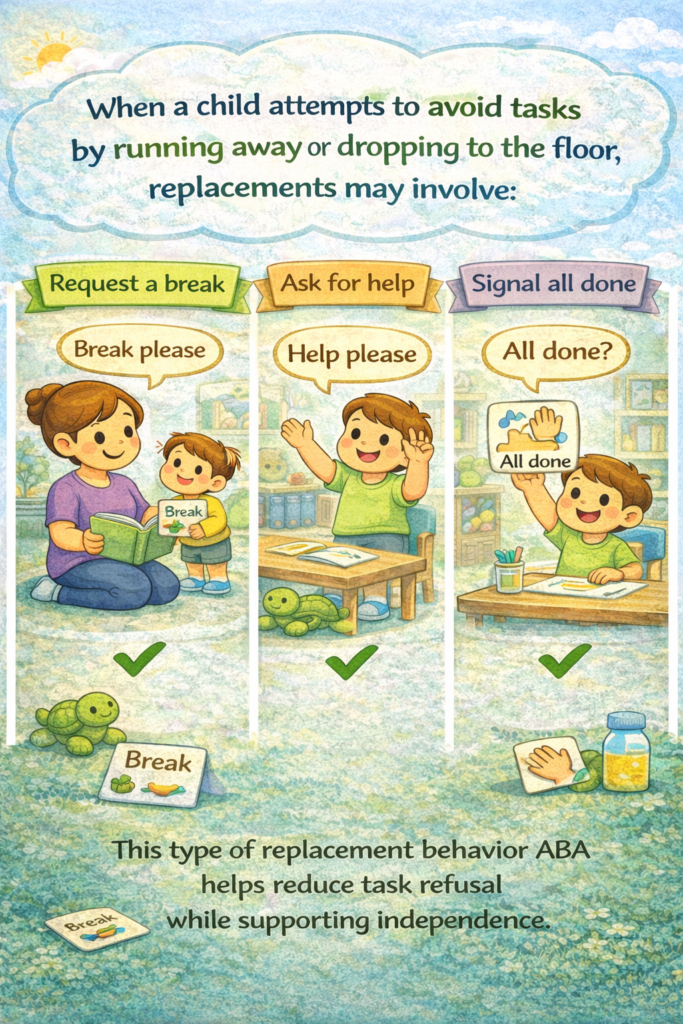
- Requesting a break rather than escaping a task
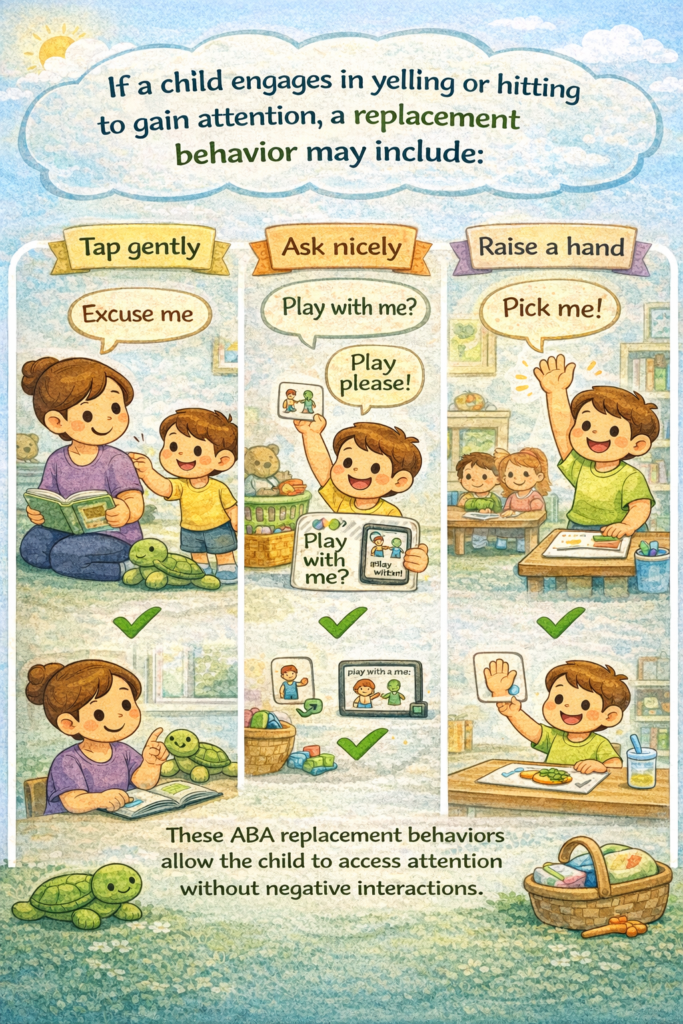
- Seeking attention appropriately instead of engaging in disruptive behavior
At Heartlinks, when parents ask us, “What is a replacement behavior in ABA?” our answer depends on the function. The new behavior must allow the child to achieve the same outcome, whether that’s attention, sensory-seeking behaviors, escape, or an item, in a socially appropriate manner.
Why Replacement Behaviors Are Important for Children With Autism

Most challenging behaviors in autism are directly connected to autism communication difficulties, problems with autism emotional regulation, or basic unmet needs. Removing the undesirable behavior in and of itself won’t solve the problem; in fact, it might lead to greater frustration or new problem behaviors. That’s why replacement behaviors are a core component of behavior reduction aba strategies.
Replacement behaviors ABA strategies are important because they:
- Teach children how to communicate needs clearly
- Support autism emotional regulation during difficult moments.
- Build socially appropriate skills that generalize across settings.
- Reduce reliance on unsafe or disruptive behaviors.
With regard to behavior replacement for autism, the goal isn’t complete compliance; it’s helping the child understand and develop the skills needed to navigate their day-to-day more successfully.
Examples of Replacement Behaviors by Function
Before selecting a replacement behavior, a certified ABA therapist must understand the purpose of a child’s autistic behavior. The following are common examples of replacement behaviors in ABA, organized by function.
Understanding why a behavior occurs is essential before choosing a replacement. Below are common examples of replacement behaviors in ABA, organized by function.
Attention-Seeking Replacement Behaviors
Escape or Avoidance Replacement Behaviors
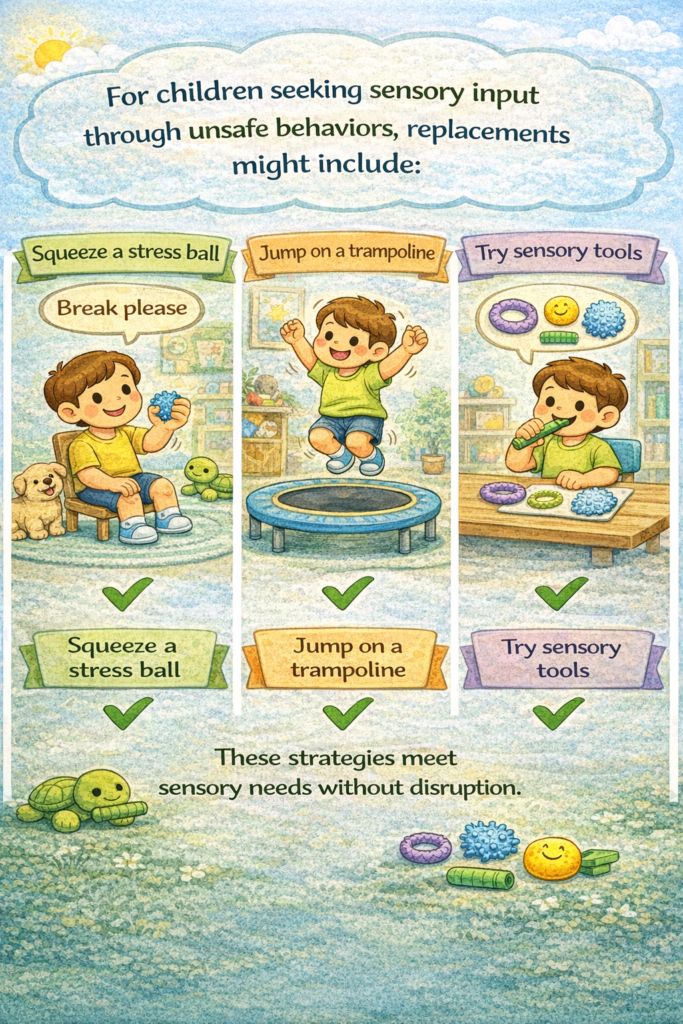
Sensory Input Replacement Behaviors
Access to Items or Activities Replacement Behaviors
Key Principles of Replacement Behaviors ABA Therapists Follow to Support Children With Autism
ABA therapists are trained to follow specific principles to ensure that replacement behaviors are not only effective in the moment but also meaningful, realistic, and sustainable for children with autism across their day-to-day lives.
1. Function-Based Decision-Making
A replacement behavior must serve the same function as the challenging behavior it is replacing. If a child is hitting to avoid a task, such as brushing their teeth, the replacement behavior must also allow them to escape or reduce that demand appropriately. If the function is attention-seeking, such as wanting to cuddle or talk before bedtime, the replacement behavior must reliably elicit attention.
When a replacement behavior does not meet the same need, the child has little motivation to use it. This is why understanding the reason behind a behavior is the foundation of all effective replacement behaviors and ABA strategies.
2. Making the Behavior Easier and Faster to Use
For a replacement behavior to truly replace a challenging one, it must be more efficient for the child. ABA therapists intentionally design replacement behaviors that are:
- Easier than the problem behavior
- Faster to access reinforcement
- Appropriate for the child’s communication and developmental level
If a child can scream instantly but has to work hard to communicate a request, the original behavior will likely continue. Successful replacement behaviors are simple, accessible, and immediately effective, making them the child’s best option at the moment.
3. Ensuring Social Appropriateness
Replacement behaviors must work beyond therapy sessions. A behavior that is acceptable in a clinical setting but unrealistic at home, at school, or in public is unlikely to be maintained long-term.
A certified ABA therapist focuses on teaching replacement behaviors that are:
- Safe and respectful
- Understandable to caregivers, teachers, and peers
- Functional across multiple environments
This emphasis on real-world use helps children generalize skills, reduces confusion across settings, and supports long-term independence and success.
How Replacement Behaviors Are Taught in ABA Therapy
Within the confines of a replacement behavior ABA programs for autism, it’s important to remember that a therapist must customize their methods to each child’s needs, environment, and abilities. The goal is to help an autistic child use the new behavior naturally when they need it most, rather than simply teaching them a new skill. Most replacement behaviors are formally introduced as part of a (behavior intervention plan) BIP in aba, ensuring consistency and ethical implementation.
Teaching the New Skill Explicitly
Replacement behaviors are taught directly and intentionally. Rather than showing the child what to do, a trained ABA therapist must clearly demonstrate the behavior by modeling it, using prompts as needed, and practicing the new skill in a variety of environments.
Whether it’s during play time, at school, during transitions, or while learning new tasks, there are many opportunities for a BCBA therapist to help a child practice the new behavior rather than just learn what it looks like.
Reinforcing the Replacement Behavior
Immediate and meaningful ABA positive reinforcement should occur when an autistic child successfully uses the replacement behavior. Whether that includes attention, access to a preferred item, a break, or a sweet treat, whatever motivates the child, the reinforcement must be consistent. This way, it will help the child learn that the replacement behavior is the most appropriate and effective way to have their needs met. In turn, consistent reinforcement helps the child learn that the replacement behavior is the most effective and reliable way to have their needs met, making it more likely to occur again.
Reducing Reliance on the Challenging Behavior
As the replacement behavior becomes more consistent, therapists carefully reduce the ABA negative reinforcement for the challenging behavior. This process is gradual and ethical, ensuring the child is never left without a means of autism communication or coping.
Over time, the child begins to rely less on unsafe or disruptive behaviors and more on skills that support communication, emotional regulation, and independence, leading to lasting, positive behavior change.
How Parents Can Support Replacement Behaviors at Home Using ABA Therapy Strategies
Parents play a critical role in helping replacement behaviors succeed with ABA strategies outside therapy sessions.
Consistency Across Environments
Using the same language, visuals, and expectations across settings helps children generalize skills more effectively.
Reinforcing the Right Behavior at the Right Time
Immediate praise or access to reinforcement when the replacement behavior occurs strengthens learning.
When to Seek Professional ABA Support
If behaviors escalate, persist, or interfere with daily life, professional ABA support can help identify the function of the behavior and teach effective, safe alternatives.
How ABA Therapy Promotes Lasting Behavior Change in Children With Autism
Long-term behavior change doesn’t come from merely stopping behaviors; it comes from teaching new skills. It’s the job of trained ABA professionals to help children on the spectrum build the tools they need to use throughout their lives.
At Heartlinks ABA, we take the time to introduce replacement behaviors thoughtfully and compassionately. Our goal is to ensure that the child is supported across environments to help them with autism grow, in safer, more effective ways to express themselves, at their own pace, and in ways that respect who they are, for long-term independence.
With locations throughout this country, including the following:
If you’re navigating challenging behaviors and looking for supportive, evidence-based guidance, connecting with an experienced ABA team can help you better understand your child’s needs and the positive alternatives available to support lasting growth.
Replacement Behaviors ABA FAQs
- What defines a replacement behavior in ABA?
A replacement behavior is a socially acceptable action that meets the same need as a challenging behavior while being safer.
- What are examples of replacement behavior for autism?
Examples of replacement behavior for autism include asking for help rather than escaping, requesting attention appropriately, and using sensory tools instead of engaging in unsafe behaviors.
- How do ABA therapists teach replacement behaviors effectively?
Trained ABA therapists teach replacement behaviors using several different techniques, including modeling, prompting, reinforcement, and consistency across environments.
- Can replacement behavior ABA programs reduce aggression or tantrums?
Yes. When the replacement behavior meets the child’s needs more efficiently than the problem behavior, aggression and tantrums often decrease naturally.
- Is replacement behavior therapy for autism covered by insurance?
Yes, replacement behavior therapy is typically covered under ABA coverage insurance when it is included as part of a medically necessary ABA treatment plan for a child diagnosed with autism. Coverage depends on your specific policy, provider requirements, and state mandates, so it’s important to verify benefits with your insurance company or an ABA provider.