

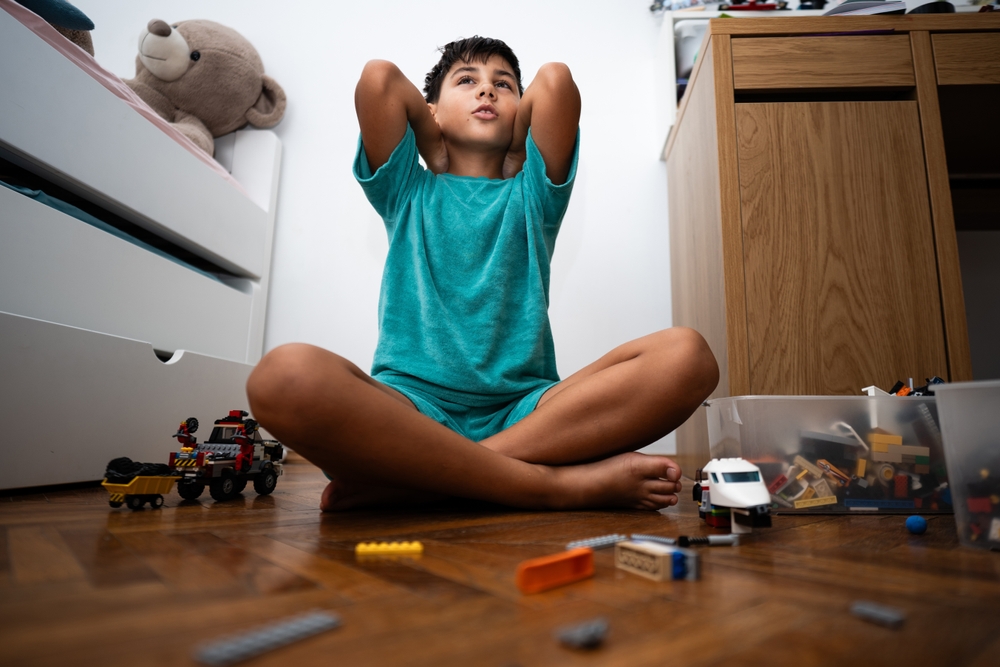
High-functioning autism (Level 1 ASD) often includes sensory processing differences, which are heightened or reduced responses to sound, light, touch, taste, or movement. These sensory issues can cause overwhelm, meltdowns, or sensory-seeking behavior. Interventions, including occupational therapy, sensory diets, and environmental adjustments, can help children manage sensory input and function more comfortably day to day.
If you’re noticing sensory-related struggles in your child, Heartlinks ABA can help you understand what’s happening and build a plan. Schedule a consultation.
What does “high-functioning autism” mean, and why are sensory issues so common
If your child was recently diagnosed, you may have heard the term “high-functioning autism” from a teacher, a pediatrician, or another parent. It’s a commonly used term, and one that applies to a meaningful share of the roughly 1 in 31 U.S. children now identified with autism spectrum disorder, according to the CDC’s most recent surveillance data. However, it’s worth understanding exactly what “high-functioning” does and doesn’t mean before we get into sensory issues themselves.
Is High-Functioning Still an Accurate Term?
“High-functioning autism” isn’t an official diagnosis. It’s informal shorthand people used to describe autistic individuals who don’t have an accompanying intellectual disability and who are able, in many settings, to communicate and manage their daily lives with fewer visible supports. The formal clinical term is Level 1 Autism Spectrum Disorder under the DSM-5, meaning a person requires the least intensive level of support among the three ASD levels.
Many autistic self-advocates and clinicians have rejected the “high-functioning” term, saying that it can undersell how much someone is genuinely struggling. For example, a child who can hold a conversation might still feel quietly overwhelmed, exhausted, or mask distress that isn’t blatantly obvious from the outside. We use the term here because it’s how most parents search for information. Still, it’s worth remembering it describes visible functioning in specific moments, not the whole picture of what a child experiences.
Why Do Sensory Processing Differences Happen?
Sensory processing is how the brain takes in information from the senses, including sound, sight, touch, taste, smell, balance, and body position, and converts it into a response. In autistic individuals, that process often works differently: a sound that seems ordinary to most people might register as excruciatingly loud, while a strong physical sensation, like deep pressure, might barely register at all.
This isn’t rare in the autism community. In 2013, the DSM-5 officially added sensory differences to the diagnostic criteria for autism. Additionally, one widely cited study found that 95% of children with autism showed some degree of sensory processing difference. Simply put, if your child has sensory sensitivities, they’re in the majority of autistic kids and by no means in the minority. Because sensory processing is so closely linked to emotional well-being, understanding this piece often explains mood and behavior patterns that otherwise seem unrelated to sensory input.
Signs and Examples of Sensory Issues in High-Functioning Autism
Sensory differences certainly don’t look the same from one child to the next. Some children are easily overwhelmed by input, while others don’t register enough of it and seek out more stimulation. Most children usually show a mix of both depending on the sense involved.
| Sensory System | What it affects | Common High-Functioning Autism Responses |
|---|---|---|
| Auditory | Sound processing | Distress at loud/sudden noise; discomfort in noisy rooms |
| Visual | Light, movement, color | Overwhelm from fluorescent lights, screens, or busy visual scenes |
| Tactile | Touch, texture | Aversion to certain fabrics, tags, food textures, light touch |
| Vestibular | Balance, movement | Seeking spinning/rocking, or avoidance of movement-based activities |
| Proprioceptive | Body position/pressure | Seeking deep pressure (hugs, weighted items) or clumsiness |
| Interoceptive | Internal body signals | Difficulty noticing hunger, pain, or the need to use the bathroom |
Hypersensitivity: Sound, Light, and Touch
Hypersensitivity means a child’s nervous system registers ordinary input as too intense. Sound sensitivity might show up as covering ears when they hear a vacuum or a hand dryer. On the other hand, visual overload can result from fluorescent classroom lighting or a cluttered, busy space. Touch sensitivity often shows up in small daily frustrations such as a shirt tag, a sock seam, or a food’s texture that seem minor to others but genuinely distressing to your child.
Hyposensitivity and Sensory Seeking
Hyposensitivity works the other way: the nervous system needs more input to register it. A child might not notice they’re cold, seem unusually tolerant of pain, or crave ongoing movement. This often shows up as sensory-seeking behaviors, including spinning, jumping, crashing into furniture or people, chewing on non-food objects, or asking for tight hugs. These behaviors aren’t misbehavior by any means; instead, they’re the nervous system’s way of asking for the input it isn’t getting naturally through everyday movement (vestibular input) or body awareness (proprioceptive input).
Not sure if what you’re seeing is sensory-related or something else? Our team can help you tell the difference. Talk to a specialist today.
How sensory issues show up in a child’s behavior
It is rare that sensory differences stay connected to sensory moments. Instead, they seep into a child’s behavior, mood, and how a child’s day goes at school and at home, which is often where parents first notice something’s going on, even before they have language for it.
Meltdowns, Shutdowns, and Emotional Sensitivity
Two behaviors often get lumped together, but they’re distinct, and differentiating between them is crucial to respond properly.
- A meltdown is an outward response to overwhelm and includes behaviors like crying, yelling, or physical distress that a child usually can’t control in the moment. Unlike a tantrum, which aims to get something, a meltdown is the nervous system reaching its capacity.
- A shutdown is the inward version of a meltdown where a child goes quiet, withdraws, stops responding, or almost seems to check out. It can be easy to overlook because it looks calm on the surface despite the fact that the child is just as overwhelmed as they would be in a meltdown.
Both are linked to what’s sometimes termed emotional sensitivity in autism, which is a heightened reactivity that often has a sensory root. Sensory overload and anxiety frequently travel together too: when a child’s system is already working hard to manage sound, light, or touch, there’s less capacity left to regulate emotions.

Sensory Issues at School vs. at Home
Often parents of high-functioning autistic children notice a gap between how their child seems at home and what a teacher reports seeing at school. This discrepancy isn’t because one setting is right and the other is wrong. Home is often more predictable and controllable, with familiar lighting, familiar sounds, or the option to retreat to a quiet room. By comparison, school often stacks several sensory demands at once, such as fluorescent lights, a noisy cafeteria, unpredictable fire drills, scratchy uniforms, and loud and chaotic hallways between classes.
A child who seems fine at home may be masking or holding it together all day at school, then having a harder time regulating once they’re back in a safe space, which is often why some kids experience ‘meltdowns at pickup’ scenarios, even after having what seems like a good day. Sharing what you notice at home with your child’s teacher (and vice versa) can help everyone connect behavior across settings instead of treating each one as a separate mystery.
How to Reduce and Manage Sensory Issues in Children
There isn’t a single fix for sensory processing differences. That’s because every child’s sensory profile is different. But well-supported strategies can make daily life more manageable, both at home and with professional support.
Environmental and At-Home Strategies
The following are small, practical adjustments that can go a long way toward helping your child. They include:
- Noise-canceling headphones or earplugs for loud or unpredictable environments
- Weighted blankets or lap pads to provide calming proprioceptive input
- Predictable routines and warnings before transitions or new environments
- A designated quiet space at home that your child can retreat to when they become overwhelmed
- Clothing adjustments including tagless shirts, seamless socks, or softer fabrics
- Movement breaks purposefully built into the day for kids who are sensory seekers
Apart from these day-to-day tweaks, sensory play activities that support regulation, including swinging, deep-pressure play, or textured sensory bins, can also help your child build tolerance over time as opposed to only managing overwhelm in the moment it happens.
Professional Interventions: OT, Sensory Diets, and ABA Support
For many families, environmental changes do help, while professional support fills in the rest. Occupational therapy (OT) is often the front-line intervention for sensory processing differences. An occupational therapist is trained to assess your child’s specific sensory profile and design activities that can help your child regulate more effectively over time. Many OTs use a sensory diet, a personalized, scheduled set of sensory activities (i.e., swinging, brushing, or heavy work) built into the day to help a child stay regulated rather than swinging between overwhelm and emotional shutdown.
ABA (Applied Behavior Analysis) can complement this work by helping identify what triggers a meltdown or shutdown, teaching communication and coping strategies a child can use in the moment, and working alongside an OT rather than replacing it. It’s worth being open and honest: no single intervention, ABA included, is a cure for sensory processing differences, and any provider who frames it otherwise is not being truthful. Effective, individualized support can realistically offer a better understanding of your child’s sensory profile and practical tools that make their everyday environment easier to navigate. You can learn more about our ABA therapy services and how we coordinate with occupational therapists as part of one individualized plan.
Heartlinks: Understanding Your Child’s Sensory Differences is the First Step to Support
It’s important to remember that sensory processing differences are one of the most common and most manageable parts of the high-functioning autism experience. Learning to recognize hypersensitivity and hyposensitivity, understanding the difference between a meltdown and a shutdown, and connecting what you see at home with what happens at school all give you a clearer picture of what your child may or may not need. None of this requires fixing your child; it requires the opposite: it requires understanding how their nervous system works and adjusting their environment and support to fit it.
Every child’s sensory profile is unique. Heartlinks ABA can help you build a personalized plan for your child and family. Get started today.
Frequently Asked Questions About High-Functioning Autism Sensory Issues
Is sensory processing disorder the same as autism?
No. Sensory Processing Disorder (SPD) and autism are related but distinct. SPD can occur on its own, without autism, and not every autistic person meets criteria for SPD, even though sensory differences are common in both. For a closer look at the overlap and differences between SPD and autism, see our full breakdown.
What are common sensory triggers for someone with high-functioning autism?
Common triggers include loud or sudden noises, fluorescent or flickering lights, certain clothing textures or tags, strong smells, crowded or visually busy spaces, and unexpected touch. Triggers vary significantly from person to person, which is why identifying your own child’s specific triggers matters more than following a generic list.
Can adults be diagnosed with autism because of sensory sensitivity alone?
No. Sensory sensitivity alone isn’t enough for an autism diagnosis. Trained clinicians need to look at a broader pattern that also includes social communication differences and restricted or repetitive behaviors. That said, sensory sensitivity is often one of the first things adults notice about themselves before pursuing an evaluation, especially if it was overlooked in childhood.
Resources
1. Centers for Disease Control and Prevention. (2025). Data and statistics on autism spectrum disorder. https://www.cdc.gov/autism/data-research/index.html
2. Tomchek, S. D., & Dunn, W. (2007). Sensory processing in children with and without autism: A comparative study using the Short Sensory Profile. American Journal of Occupational Therapy, 61(2), 190–200. https://doi.org/10.5014/ajot.61.2.190